






- Navigation -
 Current Location:
NEWS DETAILS
NEWS INFORMATION
Top Mistakes to Avoid When Choosing a Welding Table
AUTHOR:yongxin DATE:2026-10-10 13:23:19 HITS:142
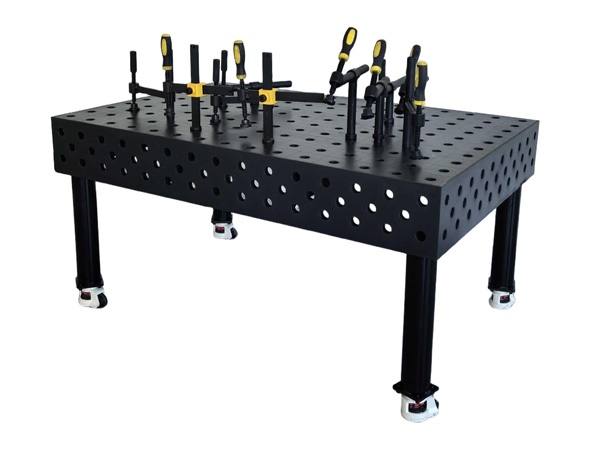
A welding table is one of the few pieces of workshop equipment that quietly determines the quality ceiling of every weld made on it. Yet it is also one of the most commonly under-specified purchases in a fabrication operation. The failures are rarely dramatic — a table that was "good enough" on the quote gradually becomes the bottleneck that forces rework, slows setup, and limits the jobs the shop can accept. Most of these outcomes trace back to a small set of predictable mistakes made at the selection stage, before anyone saw the finished product in service. This article examines those mistakes in engineering terms, so the buyer can recognize them before signing the purchase order rather than after the constraint appears.
Mistake 1: Treating Flatness as a Marketing Claim Rather Than a Verified Spec
The most common and most damaging mistake is accepting a flatness figure without asking for the measurement that supports it. Flatness is not a single number applied uniformly across a table — it is a statement about how much the working surface deviates from a true plane, and the method of measurement determines whether the number means anything.
Ask for the measurement method: A flatness claim backed by a laser scan or a coordinate measuring machine across the full surface is meaningful. A claim backed by "it's machined flat" is not, because machining does not guarantee the post-machining condition after stress relief and handling.
Ask for the tolerance form: Flatness is often stated per meter (for example ±0.05 mm/m) or across the full surface. These are different statements. A table can be excellent per meter and still have a noticeable overall bow if the full-surface tolerance is not controlled.
Ask for the documentation: A flatness report is the only evidence that the table shipped in the condition claimed. Without it, the buyer is accepting a specification that cannot be verified.
The correction is simple: specify the flatness tolerance, the measurement method, and the full-surface scope in the purchase order, and require the report as part of delivery acceptance.
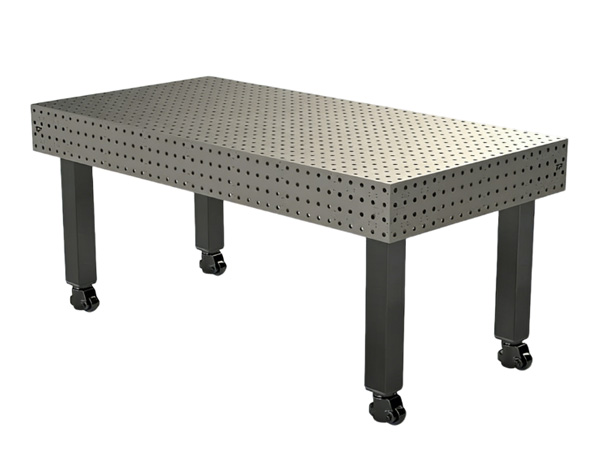
Mistake 2: Ignoring How the Load Is Actually Applied
Load rating is frequently read as a single number — "this table holds 1000 kg" — and then applied to a completely different loading scenario than the one the rating describes. A table rated for a uniformly distributed load behaves very differently under a concentrated load at one corner, which is exactly how heavy plate and structural sections are often positioned.
Distributed vs. concentrated load: Welding tables are typically rated for distributed loads. A thick plate section resting on two points near one edge creates a bending moment the distributed rating does not capture.
Eccentric loading: Work that overhangs the table edge applies a moment to the structure that the center-load rating does not represent.
Clamping forces: Heavy clamping pulls against the table structure. The table must resist these forces without deflecting the working surface, which is a separate question from static load capacity.
The correction is to describe the actual heaviest and most awkwardly positioned workpiece to the supplier, and to ask how the table's structure handles that specific loading — not to compare headline load numbers.
Mistake 3: Overlooking the Fixturing Grid Ecosystem
Buyers often focus on the table surface and treat the fixturing grid as a secondary feature. In reality, the grid standard — hole spacing, thread size, and the range of compatible components — determines whether the table is a flexible workholding system or a flat plate with holes in it.
Component availability: A grid standard is only useful if a broad range of clamps, stops, risers, and angle plates is available for it. A proprietary or narrow grid limits the shop to whatever the supplier happens to offer.
Interchangeability: Components should work across all tables of the same standard in the shop, so the fixturing library grows rather than fragments.
Future expansion: A table bought without checking the component ecosystem often cannot be extended later without replacing the entire system.
The correction is to evaluate the grid as a system, not a surface feature: confirm the component range, the interchangeability, and the supplier's commitment to the standard before purchase.
Mistake 4: Confusing Portability With Rigidity
Many buyers choose a portable bench because the workshop is tight on space, then discover that portability and rigidity are in tension. A table on casters is convenient to move but resists the very thing precision welding needs — a stable, immovable reference.
Mobile work: If the welding surface genuinely needs to move between operations, a bench or a mobile table is the right call, and the rigidity trade-off is accepted as part of the application.
Fixed-station work: If the welding is a core, repeatable operation, a floor-anchored table provides the stability that portable options compromise.
The wrong compromise: The mistake is buying portable when the work is fixed, or fixed when the work is mobile — choosing on price or habit rather than on how the work actually flows.
The correction is to map the workflow first: where does the welding happen, does the surface need to move, and what stability does the work require? The answer determines the structure, not the reverse.
Mistake 5: Skipping Verification of Stress Relief and Material Certification
Stress relief is the stage that most determines whether a fabricated steel table holds its flatness over years, yet it is the easiest to omit from a low-cost build. Buyers who do not ask for it often receive a table that is flat on arrival and distorted within months.
Why it matters: Machining leaves residual stresses in the plate. Without stress relief, those stresses redistribute under thermal cycling and service, distorting the surface.
What to require: A heat treatment record showing the temperature cycle and cooling rate, plus a mill test certificate for the steel grade.
The cost of omission: A table that distorts cannot be returned to flatness without re-machining, which is a far larger cost than verifying the process upfront.
The correction is to make stress relief records and material certificates acceptance criteria, not optional extras.
Mistake 6: Underestimating Surface Treatment and Maintenance
The working surface is the part of the table that interacts with every workpiece and every spatter droplet. Buyers who treat surface finish as cosmetic often face accelerated wear, spatter adhesion, and corrosion that degrades the working surface faster than expected.
Bare steel: Lowest cost, but requires disciplined oiling and cleaning to avoid rust and spatter bonding.
Surface hardening: Nitriding or induction hardening improves wear resistance substantially and reduces spatter adhesion, extending the useful life of the surface.
Maintenance plan: The table's life depends on a defined cleaning and protection routine. Buying a hardened surface and then neglecting it wastes the investment.
The correction is to match the surface treatment to the operating environment and to define the maintenance routine as part of commissioning, not after the surface has already degraded.
Mistake 7: Buying on Price per Square Meter
The single most common error in procurement is comparing tables by price per square meter of surface. This metric ignores everything that makes a table perform: flatness, structure, grid ecosystem, stress relief, and surface treatment. Two tables at the same footprint and very different prices may deliver entirely different capabilities, and the cheaper one is frequently the more expensive over its life.
Total cost of ownership: Include setup time, rework from poor fixturing, surface re-machining, and the cost of limitations on the jobs the shop can accept.
Capability value: A table that enables repeat production and accurate fit-up returns value through throughput and quality, not through its purchase price.
The hidden cost: A table that becomes a constraint forces either rework or replacement — both more expensive than buying correctly the first time.
The correction is to evaluate the table as a production system purchase with a lifecycle cost, not as a commodity by area.
Mistake 8: Ignoring the Future Part Range
Many tables are specified against today's work only. When the part range expands — larger assemblies, 3D structures, automated welding — the flat table with no grid ecosystem or vertical fixturing cannot adapt, and the shop faces a second purchase.
Headroom: Specify for the part range expected over the table's life, not just the current month.
Adaptability: A modular grid system with vertical fixturing capability accommodates future complexity far better than a fixed flat surface.
Expansion path: Confirm that the chosen standard can be extended with frames, risers, and angle plates as needs grow.
A Practical Selection Checklist
The mistakes above reduce to a short checklist that any buyer can apply before purchase:
Require a flatness report with the measurement method and full-surface scope.
Describe the actual load scenarios — concentrated, eccentric, and clamping forces — to the supplier.
Evaluate the fixturing grid as a system with a verified component ecosystem.
Map the workflow to decide between portable and fixed-station structure.
Make stress relief records and material certificates acceptance criteria.
Match surface treatment to the environment and define the maintenance routine.
Compare on total cost of ownership, not price per square meter.
Specify for the future part range, not just current work.
Conclusion
The recurring mistakes in choosing a welding table are not about buying the wrong brand — they are about buying against the wrong criteria. Flatness claimed but not verified, load read as a single number, the fixturing grid treated as an afterthought, portability confused with rigidity, and price per square meter used as the deciding metric: each of these turns a capable table into a future constraint. The correction in every case is to specify in engineering terms — measurement method, actual load scenarios, grid ecosystem, workflow fit, process documentation, and lifecycle cost — and to require evidence rather than claims. A buyer who applies the checklist above will select a table that supports the work for years rather than one that limits it. For a specification review against your actual workpiece range, the technical team can assist in translating the checklist into a purchase order that protects the investment.
Frequently Asked Questions
What flatness tolerance should I require for a welding table?
The appropriate tolerance depends on the work. For general fabrication, an industrial precision class such as ±0.05 mm/m is a common reference, but the more important point is to require the measurement method and full-surface scope in writing, and to obtain the flatness report as acceptance evidence. The number alone means little without the method.
Is a higher load rating always better when choosing a welding table?
Not necessarily. Load rating must be interpreted against how the load is actually applied — concentrated, eccentric, and clamping forces behave differently from a distributed rating. A table matched to your real loading scenario is better than an oversized one bought on a headline number, provided the structure handles your worst-case position.
Why does the fixturing grid matter more than the table surface?
The grid standard determines whether the table is a flexible workholding system or a flat plate with holes. A broad, interchangeable component ecosystem lets the shop build a reusable fixturing library and expand later. A proprietary or narrow grid locks the shop into limited options and often forces system replacement when needs grow.
How important is stress relief in a fabricated steel welding table?
It is one of the most important factors for long-term flatness. Machining leaves residual stresses that redistribute over time and with thermal cycling, distorting an unrelieved surface. Requiring a stress relief record and a material certificate is the practical way to avoid a table that is flat on arrival but distorted within months.
Should I buy the cheapest welding table per square meter?
No. Price per square meter ignores flatness, structure, grid ecosystem, stress relief, and surface treatment — everything that determines performance. Evaluate the table on total cost of ownership, including setup time, rework, surface re-machining, and the jobs the table can or cannot support over its life.
References
Kou, S. (2021). Welding Metallurgy (3rd ed.). Wiley.
ASM International. (2011). ASM Handbook, Volume 6: Welding, Brazing, and Soldering. ASM International.
American Welding Society. (2020). AWS D1.1/D1.1M: Structural Welding Code — Steel. American Welding Society.
Kalpakjian, S., & Schmid, S. R. (2019). Manufacturing Engineering and Technology (8th ed.). Pearson.
Groover, M. P. (2019). Fundamentals of Modern Manufacturing: Materials, Processes, and Systems (7th ed.). Wiley.
-
Top Mistakes to Avoid When Choosing a Welding Table
-
Precision Welding Tables in Aerospace Manufacturing
-
Welding Bench vs Welding Table: Which One to Choose?
-
Steel Welding Table Fabrication Process Explained
-
Modular Fixture System in Automated Welding Lines
-
3D Flexible Welding Platform for Smart Factories
Hebei Yongxin Measuring Tools
Copyright © 2025-2026 http://www.yx-weldingtable.com. All Rights Reserved Hebei Yongxin Measuring ToolsCopyright