






- Navigation -
 Current Location:
NEWS DETAILS
NEWS INFORMATION
Welding Bench vs Welding Table: Which One to Choose?
AUTHOR:yongxin DATE:2026-10-02 12:07:08 HITS:150
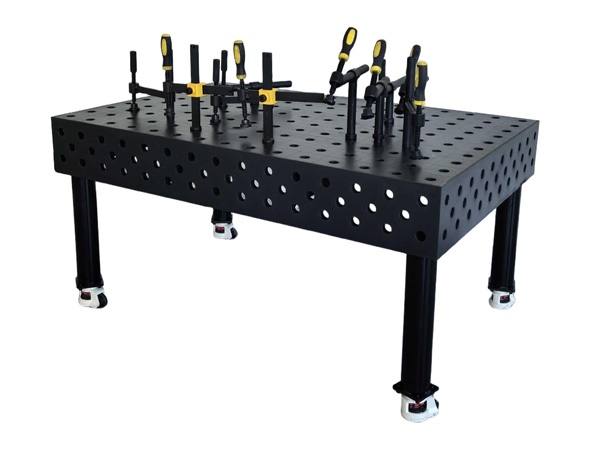
In most fabrication shops, the conversation about workholding begins with a simple question: should we buy a welding bench or a welding table? The answer is not immediately obvious, because the two terms are sometimes used interchangeably and the products themselves occupy overlapping territory. Yet the practical differences between them are real, and the right choice affects how efficiently work is fixtured, how accurately parts are joined, and how quickly the shop can turn jobs around. This article sets aside the marketing language and examines what each option actually delivers — in structure, in function, and in the types of work it suits best.
Defining the Two Types of Workholding Platforms
Before comparing them, it helps to define what a welding bench and a welding table actually are, because the distinction matters more than the terminology.
A welding bench is fundamentally a work support — a sturdy, usually steel or steel-tube structure that provides a flat surface at a workable height. Benches range from simple angle-iron frames with a plate on top to relatively sophisticated portable units with integrated clamping and stop systems. The emphasis is on providing a stable, elevated work surface that a welder can stand at comfortably.
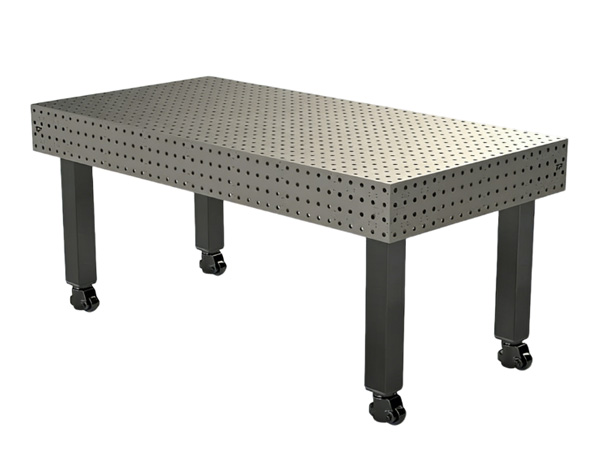
A welding table, in the context of precision and modular fixturing, is a purpose-engineered workholding platform with a standardized grid of threaded holes, a machined flat surface, and a structure designed to resist deflection under load. The grid pattern is what separates a welding table from a bench: it allows fixturing components to be positioned anywhere on the surface with known, repeatable geometry.
Structural Differences That Drive Performance
The engineering gap between a bench and a table originates in their structural design. Understanding this gap makes the comparison concrete:
Surface flatness: A welding table is machined flat to a stated tolerance, typically in the range of ±0.05 mm/m for industrial precision classes. A welding bench may be flat when new, but flatness is not its primary design specification — it is a by-product of the construction rather than a controlled parameter.
Structural rigidity: Tables are engineered to resist deflection under concentrated loads and clamping forces. A bench's tube or angle frame may flex under heavy or eccentric loading, which matters for dimensional accuracy even if it does not matter for simple tack-and-weld jobs.
Grid system: The threaded grid on a table is the central feature that enables modular, reproducible fixturing. A bench typically has no grid, or at most a few bolt holes for mounting specialized fixtures — which is a fundamentally different fixturing paradigm.
Material: Tables commonly use cast iron or machined steel plates, chosen for flatness retention and vibration damping. Benches are often fabricated from structural steel sections, optimized for strength and cost rather than surface performance.
These differences are not about quality — a well-built bench is not "worse" than a table. They are about what each platform is optimized for, and misapplying one where the other is needed is where the real cost appears.
Load Capacity and the Nature of the Work
The decision frequently comes down to what the shop actually welds. Load capacity is the most direct way to match the platform to the work:
Light to medium fabrication: A bench handles the load comfortably, and the grid fixturing of a table may be unnecessary overhead if most jobs are simple tack-welded assemblies.
Heavy plate and structural sections: A heavy-duty welding table with appropriate load ratings absorbs the concentrated forces from thick sections without deflection. A bench of equivalent load rating may be available, but it will not provide the grid fixturing that makes complex heavy assemblies reproducible.
Repetitive production: When the same assembly is run repeatedly, the table's grid enables fixture setups that are documented and repeatable. A bench requires the operator to re-create clamping positions by eye each time, which introduces variability and lost time.
Prototype and job-shop work: The bench's simplicity and lower cost suit the variable, one-off nature of job-shop welding, where the setup changes every job and the investment in table fixtures may not be recovered.
Fixturing Capability: The Core Functional Difference
The grid system is not just a feature — it changes the nature of workholding from a craft activity to an engineering activity. This has concrete consequences:
Repeatability: A part fixtured at a known grid position on a table can be removed and re-set to the same position later. This is essential for production welding where the fit-up must match the welding sequence and the inspection criteria.
Force distribution: Clamps on a table distribute forces through the grid into the full table structure, which resists the clamp load uniformly. On a bench, clamps may deform or damage the surface, particularly with heavy pulls.
Fixture interchangeability: Modular clamping components designed for a grid table work across any table of the same standard, which simplifies fixture procurement and allows shops to build up a fixturing library over time.
3D and multi-angle work: Some tables support vertical and angled fixturing through integrated framing or modular riser systems. A bench typically provides only the horizontal surface.
For a shop that relies heavily on custom fixturing — holding odd shapes, forcing alignments, positioning multiple components simultaneously — the table's grid system is a capability multiplier. For a shop that mainly clamps parts flat and runs simple welds, that capability may not justify the cost.
Portability and Workshop Integration
Portability is one area where the welding bench has a clear structural advantage. A bench on casters or a simple frame can be moved to where the work is, which matters in shops with limited floor space or where welding is part of a larger assembly process rather than the primary activity.
Tables, particularly heavy ones, are typically floor-anchored for stability under load. Moving them is a significant operation. This creates a practical distinction:
Mobile work: A bench is appropriate when the workholding surface needs to move — to the cutting station, the assembly bay, the paint area.
Fixed-station production: A table belongs in a dedicated welding station where the workflow is organized around it, and where its immobility is an asset rather than a limitation.
Multi-cell operations: Several smaller benches may serve a shop better than one large table if the production flow involves multiple parallel welding points.
Expansion and re-layout: A shop planning layout changes should weight portability and re-configurability more heavily, favoring benches or modular table systems with removable framing.
Cost Comparison and Return on Investment
The upfront cost difference between a bench and a table reflects genuine engineering differences, and it is worth examining what the buyer is paying for:
Bench: A basic fabricated steel bench costs substantially less than a machined welding table of equivalent footprint. The value proposition is straightforward: a stable work surface at a low entry price.
Table: The machining cost — flat surface preparation, grid drilling and threading, stress relief — adds to the material and structural cost. That premium buys flatness, rigidity, and modular fixturing capability.
Accessories: A table requires a clamping kit to function as a fixturing system, which adds 20–30% to the total system cost. A bench needs no such investment.
Return calculation: The table's value shows up in reduced rework, faster setup for repeat jobs, and better dimensional control — benefits that compound over time in production environments. In intermittent job-shop work, that return may not materialize before the table is obsolete.
The right framework for the comparison is not "which is cheaper" but "which delivers more value at the production intensity and job mix we actually run."
Which One to Choose: A Practical Decision Framework
After weighing the structural, functional, and economic differences, the decision usually reduces to a few practical questions about the shop:
What is the heaviest, most complex workpiece you regularly weld? If that job requires the accuracy and fixturing capability of a table, the table should be the baseline, and a bench becomes a supplementary surface for lighter work.
How much of your work is repetitive? The more repeatable the work, the more the table's grid system pays for itself through faster setup and consistent quality.
Do you move the workholding surface between operations? If the welding station is not fixed, a bench or a mobile table system is more practical.
What is the fixturing challenge on your hardest jobs? If your most difficult jobs involve holding odd geometries, forcing alignments, or positioning multiple components precisely, the table's modular fixturing solves problems that a bench cannot.
Many successful fabrication shops own both: a heavy-duty welding table in the dedicated welding station for production work, and a portable bench for lighter or one-off jobs that do not justify a table setup. The key is matching each platform to the work it handles best, rather than asking one piece of equipment to do everything.
Conclusion
The welding bench vs welding table decision is ultimately about matching workholding to workflow. A bench provides a stable, portable, cost-effective work surface for general fabrication — the right choice for light to medium work in variable job-shop environments. A welding table provides precision flatness, a modular grid fixturing system, and structural rigidity that serves production welding where accuracy, repeatability, and complex setup are routine. Shops that understand which of these capabilities their work actually requires make the right choice on the first purchase. Those that choose based on budget alone often discover that the cheaper option became a constraint, not an asset, as the workload grew.
Frequently Asked Questions
What is the main difference between a welding bench and a welding table?
The primary difference is the grid fixturing system. A welding table has a standardized pattern of threaded holes that accept modular clamps and fixtures, enabling precise, repeatable positioning. A welding bench is a work support without this grid system, providing a flat surface for general clamping and tack-welding tasks.
Can a welding bench handle heavy plate welding?
Heavy-duty welding benches are available with load ratings suitable for thick plate and structural sections. However, a bench typically lacks the flatness control and grid fixturing of a purpose-engineered table, which may matter for dimensional accuracy even if the load itself is within the bench rating.
Is a welding table worth the extra cost for a small fabrication shop?
It depends on the job mix. A shop running mostly one-off or light fabrication may not recover the table's cost through fixturing benefits. A shop running repeat production or requiring precise fit-up will typically find the table pays for itself through faster setup and reduced rework.
Can I use modular clamps on a welding bench?
Standard modular clamps are designed for threaded-grid tables. Some benches have bolt patterns for mounting specific fixtures, but the fixture interchangeability and positional precision of a grid table are not available on a standard bench without significant custom work.
Should I get a bench, a table, or both?
Many shops benefit from owning both: a heavy-duty welding table in the dedicated welding station for production and precision work, and a portable bench for lighter jobs, one-off assemblies, and mobile workholding needs. The combination covers the full range of the shop's work more effectively than either piece alone.
References
Kou, S. (2021). Welding Metallurgy (3rd ed.). Wiley.
ASM International. (2011). ASM Handbook, Volume 6: Welding, Brazing, and Soldering. ASM International.
American Welding Society. (2020). AWS D1.1/D1.1M: Structural Welding Code — Steel. American Welding Society.
Kalpakjian, S., & Schmid, S. R. (2019). Manufacturing Engineering and Technology (8th ed.). Pearson.
Groover, M. P. (2019). Fundamentals of Modern Manufacturing: Materials, Processes, and Systems (7th ed.). Wiley.
-
Welding Bench vs Welding Table: Which One to Choose?
-
Steel Welding Table Fabrication Process Explained
-
Modular Fixture System in Automated Welding Lines
-
3D Flexible Welding Platform for Smart Factories
-
Precision Welding Platform for High-End Manufacturing
-
Industrial Welding Table Selection for Manufacturing Plants
Hebei Yongxin Measuring Tools
Copyright © 2025-2026 http://www.yx-weldingtable.com. All Rights Reserved Hebei Yongxin Measuring ToolsCopyright