






- Navigation -
 Current Location:
NEWS DETAILS
NEWS INFORMATION
Modular Fixture System in Automated Welding Lines
AUTHOR:yongxin DATE:2026-09-26 11:21:23 HITS:194
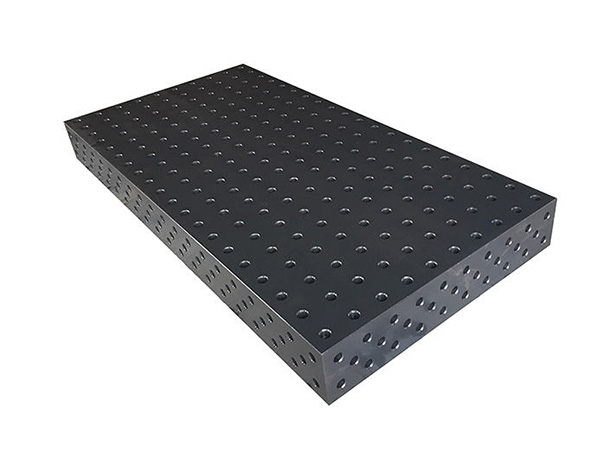
Automation has changed the economics of welding workholding in ways that are still being worked through in production environments. A hard fixture — a custom jig built for one specific part — was an acceptable investment when the production run lasted years. It is a poor investment when the product mix changes quarterly, when the production line is expected to handle multiple part families on the same station, or when the plant is targeting faster changeover as a primary efficiency lever. The modular fixture system exists as an engineering response to this changed environment: a standardized library of fixturing components, designed to be combined in different configurations to handle different parts, without custom tooling per job. For automated welding lines in particular, this flexibility is not just convenient — it is often the condition under which automation investment makes financial sense at all.
Why Automated Welding Lines Have Special Fixturing Requirements
Automated welding introduces workholding requirements that manual welding does not. Understanding these requirements is the starting point for evaluating any fixturing approach:
Repeatability: An automated welding system executes a pre-programmed path. The workpiece must be in exactly the same position each cycle, because the path was taught to a specific geometry. A deviation of a few millimeters in part position can cause the weld to miss the joint entirely or deposit metal where it is not needed.
Cycle time discipline: Automation's productivity advantage depends on consistent cycle times. Any operation that varies from cycle to cycle — including fixture setup and part loading — degrades the automation ROI. The fixture must enable fast, consistent loading.
Force resistance: During automated welding, the part must not move as the weld head traverses or as the weld pool forms. Clamping forces must hold the part rigidly against welding distortion forces, particularly for thinner sections where heat input has a proportionally larger effect on dimensional stability.
Integration with positioning systems: Automated welding cells often use rotary positioners, tilt-turntables, or multi-axis manipulators to present the weld joint in the optimal position to the welding torch. The fixture must interface with these positioning systems and must not obstruct the weld path or the weld head.
A hard fixture for automated welding is designed to meet all of these requirements for one specific part. A modular fixture system is designed to meet them for any part within its envelope — which is a fundamentally different engineering challenge.
The Architecture of a Modular Fixture System
A modular fixture system is not a single product — it is a platform composed of standardized components that are combined differently for different parts. The architecture typically includes:
Base plate: The precision-machined plate with a grid of threaded holes that is the foundation of the system. The grid spacing and thread size are the standard that all other components reference. The base plate may be mounted on a positioner, a roller bed, or a fixed station.
Locating elements: Stop pins, dowel pins, and edge locators that reference the workpiece against the grid datums. These determine where the part sits on the table and must locate the part consistently to within the repeatability requirement.
Clamping elements: Step clamps, flat clamps, toe clamps, and spring clamps that hold the workpiece against the locating elements. In automated lines, pneumatic or hydraulic clamps that can be actuated as part of the cycle are common.
Supporting elements: Risers, V-blocks, angle plates, and nests that support the workpiece geometry — particularly important for parts with irregular profiles, tube sections, or cutouts that would otherwise sag or rock.
Bracing elements: Struts, props, and back supports that resist the forces from welding distortion, particularly for thin-walled sections or assemblies where clamping alone does not provide sufficient stiffness.
Connection hardware: Bolts, washers, and locating bushings that connect all components to the grid plate. The quality and precision of this hardware directly determines the repeatability of the assembled fixture.
The system's value comes from the reusability of these components across many different part configurations — and from the fact that new part configurations can be created by recombining existing components rather than designing and building new hard fixtures.
Reconfigurability and Changeover Speed
The primary operational benefit of a modular fixture system is the reduction in changeover time when switching between part families. This benefit is most significant in high-mix automated production:
Documentation of fixture configurations: Each fixture setup is documented by the grid coordinates of each component. When the same part runs again, the setup is reproduced by placing each component at its recorded position. This eliminates the re-teaching that would otherwise occur when a fixture is built differently each time.
Changeover labor: On a well-designed modular system, the changeover crew removes one set of components and installs the next set. With practice, this can be accomplished in a defined, repeatable time — which is exactly what OEE calculation requires.
Pneumatic and automatic clamping: For automated lines, the clamping system can be integrated with the cell control logic: the robot signals ready, the clamping system actuates, the weld runs, the clamping releases, the part is unloaded. This removes human variability from the clamping step entirely.
Kit preparation: In some facilities, the fixture kit for the next run is prepared while the current run is in progress, at a separate staging area. The prepared kit is brought to the station and installed as a complete unit, further reducing station downtime during changeover.
Precision and Repeatability in Automated Environments
The engineering challenge in a modular fixture system for automated welding is maintaining positional precision through repeated assembly and disassembly cycles. Several factors determine whether a modular system achieves the repeatability that automated welding requires:
Thread quality: The grid threads receive and release fixture components many hundreds of times in service. If the threads wear or deform, component positions drift. High-quality threaded inserts or hardened thread surfaces extend thread life substantially.
Locating pin accuracy: Dowel pins that locate components relative to each other must have consistent dimensions and should be inspected and replaced on a defined schedule. Worn pins are a common source of unexplained positional drift in otherwise well-engineered modular systems.
Base plate flatness: The precision machined base plate is the reference for all component positions. Its flatness must be maintained through the life of the system, and it should be re-verified periodically to confirm the reference surface has not drifted.
Thermal expansion: In production environments where ambient temperature varies, or where the welding process heats the fixture, thermal expansion of the grid and components introduces small but potentially significant positional errors. The magnitude of this error depends on the coefficient of thermal expansion of the materials and the temperature differential, and should be quantified for precision applications.
Integration with Smart Manufacturing Systems
Modular fixture systems fit naturally into smart manufacturing environments because they produce data that conventional hard fixtures do not. This data integration is one of the less-discussed but more significant advantages of the modular approach:
Digital fixture records: The grid coordinates of each fixture configuration can be stored as a digital file — a fixture program — that can be retrieved, modified, and shared. This turns fixture knowledge from tribal knowledge held by specific operators into a documented, transferable asset.
Traceability: When a fixture configuration is documented and traceable, the welding process becomes more traceable. The fixture setup that was used for a given production run can be linked to the production records, which supports quality system requirements in regulated industries.
Simulation and offline programming: Automated welding systems are increasingly programmed offline — the robot program is written on a computer before the part is available for teaching. A documented, grid-referenced fixture configuration allows the offline program to reference the same geometry that will be present when the program runs on the actual production line.
Process feedback: When a modular fixture system is combined with in-process measurement — a laser scanner that verifies part position before welding begins — the feedback loop closes. Any positional deviation is detected and corrected before the weld is started, which eliminates the scrap that results from a bad fixture setup.
Evaluating the ROI of a Modular Fixture System
The decision to invest in a modular fixture system is fundamentally an economic one. The return calculation should be based on the actual operational characteristics of the production line:
Hard fixture replacement cost: Each custom hard fixture has a design cost, build cost, and lead time. A modular system replaces the need for new hard fixtures with the purchase of new components, which in high-mix environments is usually substantially cheaper and faster.
Changeover time reduction: Quantify the current changeover time for the production line, the target changeover time with a modular system, and the production value gained per hour of changeover reduction. This is usually the largest single component of the ROI calculation.
Reduced scrap from fixture errors: Inconsistent manual fixture setups are a source of scrap and rework. Modular systems reduce this by making the setup reproducible. The scrap reduction value should be estimated from the current scrap rate and the expected improvement.
Flexibility value: This is harder to quantify but real: the ability to run new part families without new hard fixtures gives the production line a capability that has strategic value beyond the immediate changeover calculation.
Lifecycle cost: The modular system has ongoing costs — component replacement, thread maintenance, base plate re-verification — that should be included in the total cost comparison against hard fixtures over the planning horizon.
When a Hard Fixture Is Still the Right Choice
Despite the flexibility advantages of modular systems, there are situations where a custom hard fixture is still the correct engineering choice:
Very high volume, single part: For a part that will run for years in a dedicated automated cell, the per-part cost of a hard fixture may be lower than the amortization of a modular system and the labor to operate it.
Extremely tight tolerances: Some precision assemblies require fixturing accuracy that is beyond what a modular system can reliably deliver, because the accumulated positional errors from component fit-up exceed the tolerance budget. In these cases, a dedicated hard fixture with a machined-to-size locating surface may be necessary.
Parts with hazardous handling requirements: Some welded assemblies — pressure vessels, structural components for regulated applications — require fixture designs that are validated as part of the welding procedure. The validation is specific to the fixture geometry, and using a different fixture may require re-qualification.
The modular fixture system is not a replacement for all custom fixtures — it is a better solution for the range of situations where flexibility, changeover speed, and multi-part capability provide operational value.
Conclusion
The modular fixture system addresses a specific challenge in automated welding: how to achieve fast, repeatable, reconfigurable workholding in production environments with multiple part families and changing production requirements. Its value proposition is built on documented grid-based configurations, consistent positional repeatability, and integration with the data systems of smart manufacturing. For production engineers evaluating it, the ROI calculation should begin with the actual changeover time, scrap rate, and new part introduction frequency of the target production line — because those numbers determine whether the modular investment pays, and how quickly. Used in the right application — high-mix, frequent changeover, automated welding — a modular fixture system is often the enabling technology that makes the automation investment economically viable.
Frequently Asked Questions
What is a modular fixture system in welding?
A modular fixture system is a library of standardized fixturing components — clamps, stops, risers, and support elements — that attach to a precision grid plate. Components are combined in different configurations to fixture different parts, without building custom hard fixtures for each new part. This reconfiguration capability supports fast changeover in automated welding lines.
How does a modular fixture system reduce changeover time?
Each fixture configuration is documented by the grid coordinates of each component. When switching to a new part, the crew installs components at their recorded positions rather than designing and building a new fixture. With pneumatic or automatic clamping, the changeover can be completed in a defined, reproducible time that feeds directly into OEE calculation.
What precision can a modular fixture system achieve?
Positional repeatability depends on thread quality, dowel pin accuracy, and base plate flatness. Well-engineered modular systems can achieve repeatability within ±0.05 mm under controlled conditions. For automated welding applications requiring sub-millimeter accuracy, the accumulated positional errors from component fit-up should be quantified and compared against the tolerance budget.
Can a modular fixture system be used with robotic welding?
Yes. Modular fixture systems are well-suited to robotic welding because the documented, reproducible positioning allows offline programming — the robot program can be written referencing the same fixture geometry that will be present on the production line. Pneumatic clamping integrated with the cell control logic further reduces human variability in the process.
When should a custom hard fixture be chosen over a modular system?
A custom hard fixture is still appropriate for dedicated high-volume production of a single part over a multi-year horizon, for applications requiring tolerances that exceed what a modular system can reliably deliver, and for regulated applications where the fixture geometry is part of the welding procedure qualification. For high-mix production with frequent changeover, the modular system is typically the better choice.
References
Groover, M. P. (2019). Fundamentals of Modern Manufacturing: Materials, Processes, and Systems (7th ed.). Wiley.
Kalpakjian, S., & Schmid, S. R. (2019). Manufacturing Engineering and Technology (8th ed.). Pearson.
ASM International. (2011). ASM Handbook, Volume 6: Welding, Brazing, and Soldering. ASM International.
American Welding Society. (2020). AWS D1.1/D1.1M: Structural Welding Code — Steel. American Welding Society.
ISO 3834-2:2021. Quality requirements for fusion welding of metallic materials — Part 2: Comprehensive quality requirements. International Organization for Standardization.
-
Modular Fixture System in Automated Welding Lines
-
3D Flexible Welding Platform for Smart Factories
-
Precision Welding Platform for High-End Manufacturing
-
Industrial Welding Table Selection for Manufacturing Plants
-
Heavy-Duty Welding Table: A Buying Guide for Engineers
-
Steel Nitriding Welding Table: Proven Method to Extend Service Life
Hebei Yongxin Measuring Tools
Copyright © 2025-2026 http://www.yx-weldingtable.com. All Rights Reserved Hebei Yongxin Measuring ToolsCopyright