






- Navigation -
 Current Location:
NEWS DETAILS
NEWS INFORMATION
3D Flexible Welding Platform for Smart Factories
AUTHOR:yongxin DATE:2026-09-23 09:42:03 HITS:166
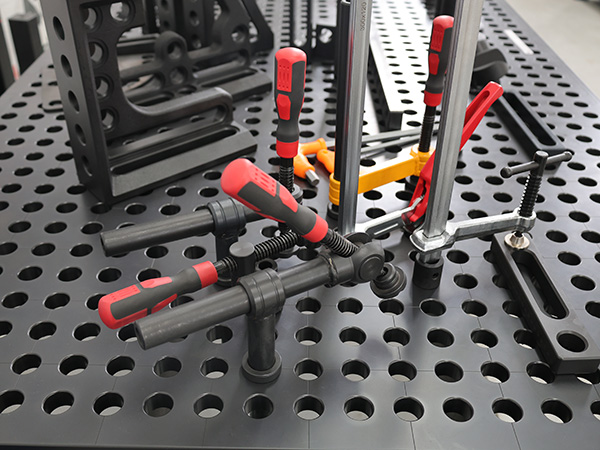
Smart factory environments impose a set of demands on welding workholding that did not exist in conventional fabrication. The production mix changes frequently. Cycle times are measured and optimized. Quality data is logged. The welding process is increasingly integrated with automated and robotic systems that require repeatable, pre-positioned fixturing. Against this backdrop, a conventional flat welding table — a surface with a grid of holes in it — is a one-dimensional solution to a multi-dimensional problem. The 3D flexible welding platform addresses the gap by treating the workholding system as a three-dimensional fixturing environment, not just a flat surface. Understanding what this means in engineering terms, and where it actually delivers value, is the purpose of this article.
What Makes a Welding Platform "3D Flexible"
The term "3D" in a welding platform refers to the fixturing envelope, not just the surface. A conventional welding table fixtures work on the horizontal plane — the part sits on the surface and is clamped from above or from the sides. A 3D flexible platform extends the fixturing grid into vertical and angled positions, allowing workpieces to be supported, braced, and referenced from multiple axes simultaneously:
Vertical grid frames: Removable or fixed vertical frames with the same grid pattern as the table surface allow clamps, stops, and support pins to be positioned in the vertical plane, enabling the workpiece to be held at height or against a vertical datum.
Angled and multi-face fixturing: The ability to fixture work at angles — not just horizontal or vertical — means that complex weld joints, which would otherwise require multiple setups on a flat table, can be presented in an optimal welding position in a single setup.
Modular combination: The 3D platform is built from modular components — base table, vertical risers, angle plates, and cross-bars — that can be reconfigured for different part geometries. This reconfigurability is the "flexible" part of the concept.
Datum referencing in three axes: When a workpiece is fixtured against datums in X, Y, and Z simultaneously, its geometry is fully constrained. This is fundamentally different from a flat surface where the part may shift or twist under welding stress.
The practical consequence is a fixturing system that can handle complex three-dimensional assemblies without custom hard fixtures — which is exactly what a smart factory running mixed production needs.
How 3D Flexible Fixturing Integrates with Automation
The smart factory is not just a label — it describes an operating environment where processes are monitored, data is collected, and automation operates on repeatable, characterized inputs. 3D flexible welding platforms are specifically well-suited to this environment in ways that conventional workholding is not:
Repeatable fixture positioning: Because the grid is modular, a fixture configuration can be documented by grid coordinates. When the same part runs again — next week or next year — the setup is reproduced by positioning fixtures at the recorded coordinates. This removes the variability that manual re-setup introduces.
Integration with robotic welding: Robotic welding cells require workpieces to be presented in a known, repeatable position so the robot's path program remains valid. A 3D platform with precise grid positioning provides this reference consistently.
Weld qualification and traceability: When fixture positions are documented and traceable, the welding setup becomes a qualified process element. This aligns with quality system requirements in sectors where weld documentation is mandatory.
Reduced changeover time: Modular reconfigurability means that changeover between part families involves removing and repositioning modular components, not building new hard fixtures from scratch. This directly improves OEE in high-mix production environments.
The integration story is not about replacing the welder — it is about giving the welding process a reliable, repeatable input so that the human operator's skill is applied to the weld quality, not to compensating for inconsistent fixturing.
Structural and Precision Engineering of 3D Platforms
A 3D flexible welding platform is a more demanding engineering product than a flat table, because it must maintain precision in three dimensions simultaneously. Several engineering factors deserve attention during evaluation:
Flatness of the base surface: The base plate of a 3D platform must meet the same flatness standards as a precision flat table, because all vertical and angled fixturing is ultimately referenced to it. A warped or distorted base propagates errors through the entire 3D structure.
Vertical frame squareness and rigidity: Vertical frames must be square to the base within tight tolerances, and they must resist the forces applied during welding — particularly when clamps pull a workpiece into alignment. Structural sections, adequate cross-bracing, and secure base connection determine whether the vertical geometry holds.
Thread and connection quality: The threaded grid on vertical frames must accept modular components with the same positional repeatability as the base surface. Inconsistent thread quality in the vertical grid defeats the reproducibility advantage of the 3D system.
Material and stress relief: Cast iron is a common material for precision platform plates because of its vibration-damping properties and dimensional stability. For 3D frames, welded steel structures must be stress-relieved after fabrication to prevent distortion from residual stress over time.
Where 3D Flexible Platforms Deliver the Most Value
The 3D flexible welding platform is not a universal replacement for a flat table — its advantages concentrate in specific application areas:
Complex structural assemblies: Three-dimensional frame structures, enclosures, and box assemblies that involve multiple weld planes benefit from 3D fixturing because the part can be held against datums in all relevant axes simultaneously.
High-mix production: Facilities running many different part numbers benefit from reconfigurable fixturing that does not require custom tooling per part family. The modularity directly reduces changeover time.
Automated and robotic welding integration: Any welding cell where a robot or automated head must have a repeatable workpiece reference is a natural application for a 3D platform with documented grid positions.
Precision fabrication with tight tolerances: Assemblies where weld distortion must be minimized through optimal welding position — and where the fit-up must be held precisely — benefit from full 3D constraint.
Prototype and pre-production runs: The ability to quickly configure a 3D fixture for a new part without building a hard tool makes 3D platforms particularly useful in development environments.
Evaluating a 3D Flexible Welding Platform: Key Specifications
When evaluating a 3D flexible welding platform for a smart factory application, focus the specification on the engineering properties that determine whether the system holds its geometry under real production conditions:
Base surface flatness: State the tolerance, the measurement method, and whether it applies to the full working surface. For industrial precision classes, look for ±0.05 mm/m or better.
Grid geometry on all surfaces: Verify that vertical frames and angle plates carry the same grid specification as the base — same hole spacing and thread size. Hybrid grids with different specifications on different surfaces reduce component interchangeability.
Structural load ratings: The platform should have separate ratings for the base surface load, the vertical frame load, and the overall system stiffness under clamping force. These are different engineering questions.
Positional repeatability: Ask for the manufacturer's data on how precisely a fixture component returns to the same position when removed and re-installed. This is the critical number for automated or repeat-production applications.
Component availability and lead times: Modular systems depend on the availability of components — frames, angle plates, brackets, and specialized clamps. Confirm supply continuity before committing to a platform with a limited or proprietary component range.
Total Cost of Ownership in Smart Factory Environments
The upfront cost of a 3D flexible welding platform is meaningfully higher than a conventional flat table, and the return calculation should reflect the operating environment:
Setup time reduction: In high-mix production, the ability to reconfigure without building new fixtures translates directly into labor savings per job changeover. Quantify this against the shop's actual changeover frequency.
Reduced scrap and rework: Accurate, repeatable fixturing reduces the misfits and weld errors that come from parts shifting during welding. In high-value fabrication, even a small reduction in scrap rate justifies significant fixturing investment.
Automation compatibility: If the shop is introducing robotic or automated welding, the platform cost should be evaluated against the integration cost of making automated welding work with less precise workholding.
Maintenance and calibration: Precision platforms require periodic flatness verification and grid thread maintenance. Build these costs into the lifecycle calculation, not after the purchase.
The 3D flexible welding platform is a production system investment, not a workbench purchase. Its value is realized over the life of the production it enables, not in the price on the purchase order.
Conclusion
The 3D flexible welding platform addresses a specific gap in advanced manufacturing: the need for workholding that is precise, repeatable, reconfigurable, and integrable with automated systems. Its core value proposition — fixturing that constrains a workpiece in three dimensions through a modular grid system — directly supports the smart factory goals of reduced changeover time, consistent quality, and traceable process control. For engineers evaluating it, the critical evaluation points are not the marketing claims but the engineering facts: flatness, grid geometry on all surfaces, structural ratings, positional repeatability, and the total cost of ownership over the production life. Platforms that deliver on those specifications are genuinely different from a flat table with a frame bolted on.
Frequently Asked Questions
What is the difference between a 3D flexible welding platform and a standard flat welding table?
A standard flat welding table fixtures work on the horizontal plane. A 3D flexible platform extends fixturing into the vertical and angled axes through integrated framing and a grid pattern on multiple faces, allowing a workpiece to be fully constrained in three dimensions without custom hard fixtures.
Can a 3D flexible welding platform be integrated with robotic welding systems?
Yes. The modular, grid-based fixturing provides repeatable workpiece positioning that is essential for robotic welding cells, where the robot's path program requires a consistent reference. Documented grid coordinates for each fixture setup enable traceability aligned with quality system requirements.
What types of parts benefit most from 3D flexible fixturing?
Complex three-dimensional assemblies — frames, enclosures, structural components with multiple weld planes — benefit most, because the 3D system can hold the part against datums in all relevant axes simultaneously. High-mix production environments also benefit from the reconfigurability without custom tooling per part family.
How repeatable is a 3D flexible welding platform setup?
When built to precision standards, a 3D platform can return fixture components to the same grid positions within tight tolerances, enabling repeatable setup for repeat production runs. The specific repeatability figure depends on the platform's thread quality, structural rigidity, and the design of the modular components.
What maintenance does a 3D flexible welding platform require?
Maintenance includes periodic flatness verification of the base surface, inspection and cleaning of grid threads on all surfaces (base, vertical frames, and angle plates), structural inspection of frame connections, and periodic re-verification of vertical frame squareness. The maintenance interval depends on production intensity.
References
Kou, S. (2021). Welding Metallurgy (3rd ed.). Wiley.
Groover, M. P. (2019). Fundamentals of Modern Manufacturing: Materials, Processes, and Systems (7th ed.). Wiley.
Kalpakjian, S., & Schmid, S. R. (2019). Manufacturing Engineering and Technology (8th ed.). Pearson.
ISO 3834-2:2021. Quality requirements for fusion welding of metallic materials — Part 2: Comprehensive quality requirements. International Organization for Standardization.
American Welding Society. (2020). AWS D1.1/D1.1M: Structural Welding Code — Steel. American Welding Society.
-
3D Flexible Welding Platform for Smart Factories
-
Precision Welding Platform for High-End Manufacturing
-
Industrial Welding Table Selection for Manufacturing Plants
-
Heavy-Duty Welding Table: A Buying Guide for Engineers
-
Steel Nitriding Welding Table: Proven Method to Extend Service Life
-
Modular Welding Table: Complete Cost vs Performance Analysis
Hebei Yongxin Measuring Tools
Copyright © 2025-2026 http://www.yx-weldingtable.com. All Rights Reserved Hebei Yongxin Measuring ToolsCopyright