






- Navigation -
 Current Location:
NEWS DETAILS
NEWS INFORMATION
Industrial Welding Table Selection for Manufacturing Plants
AUTHOR:yongxin DATE:2026-09-10 23:41:49 HITS:69
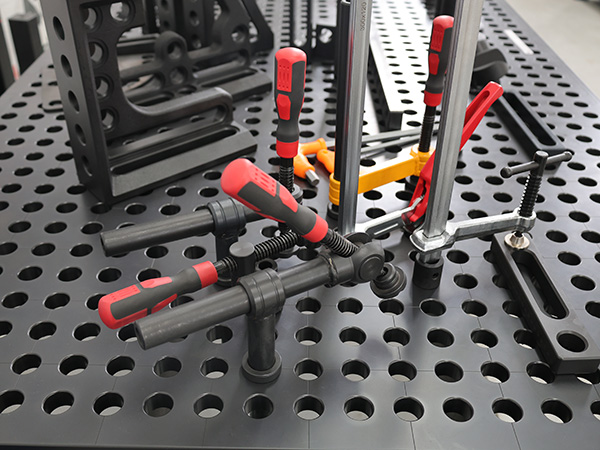
In a manufacturing plant, a welding table is not a piece of furniture — it is a precision workholding platform that determines how accurately, how quickly, and how safely welded assemblies are produced. Yet in many capital purchasing processes, the table receives far less scrutiny than the welding power source or the extraction system. That is a costly imbalance. An industrial welding table that is undersized, under-rated, or incompatible with the plant's clamping strategy becomes a bottleneck that the plant works around for years. This article provides a structured selection framework, organized in the order a buyer should actually evaluate the options: from the workpiece, to the table, to the supporting system, and finally to the plant itself.
Define the Workpiece Envelope First
Every other selection decision follows from one question: what is the largest and heaviest workpiece that will be regularly fixtured on this table? Gather data from production records rather than assumptions — the envelope is defined by the actual product mix, not by the one exceptional job that happens twice a year.
Length and width: The table should comfortably accommodate the largest regular workpiece with clearance for clamps and operator access on all sides. A common mistake is selecting a table that exactly matches the part, leaving no room for clamping hardware.
Height and three-dimensional work: Assemblies that require vertical positioning, such as frames or enclosures, need clearance above the surface. This often influences the choice of risers and angle fixturing as much as the table size itself.
Weight: Record the weight of the heaviest regular assembly including any fixtures or handling aids placed on the table. This becomes the basis for the load capacity decision.
Variety: A plant running many different part numbers needs a more flexible, modular setup; a plant running long series of one family can optimize the table around that single geometry.
Documenting the workpiece envelope in writing forces the rest of the selection process to stay anchored to production reality rather than supplier marketing.
Match Load Capacity to Real Conditions
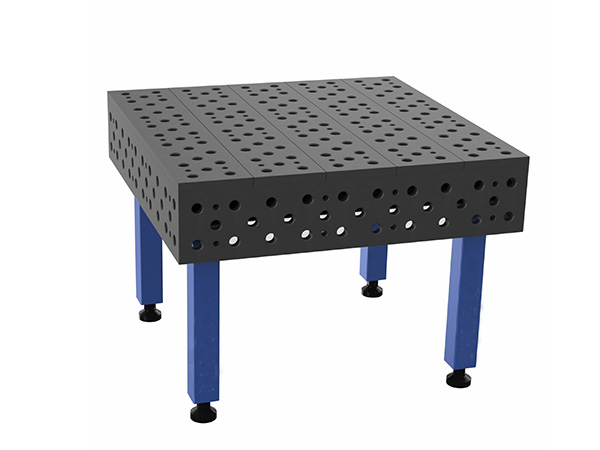
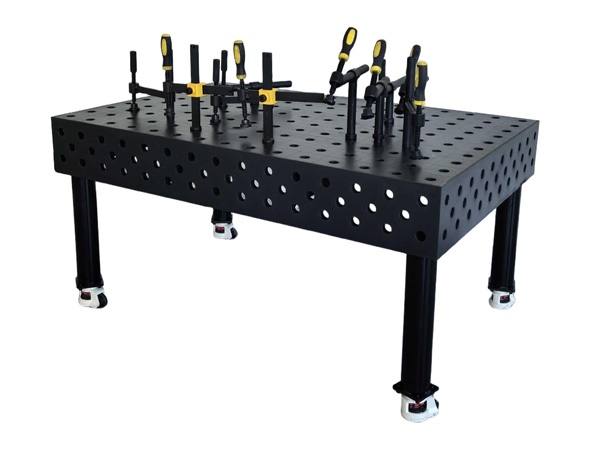
Load capacity is the most frequently misread specification in industrial welding table selection. The rated capacity printed on a specification sheet usually refers to a uniformly distributed static load. Real welding conditions are different: loads are concentrated on small areas, applied dynamically as workpieces are positioned, and combined with clamping forces that act downward and laterally.
Apply a practical safety margin: Select a table whose rated capacity is at least 1.5 times the heaviest regular workpiece, to account for concentrated loading and dynamic effects.
Consider the support structure, not just the surface: The surface plate may carry the load, but the legs, frame, and anchoring transfer it to the floor. Verify that the complete system — not just the plate — is rated for the intended duty.
Watch for deflection under eccentric loads: A workpiece clamped to one corner of a large table loads the structure unevenly. A table that is stable under a centered load may flex when the load is offset; this matters for accuracy more than for safety.
Think about handling equipment: If parts are loaded with a hoist or crane, account for the dynamic impact of the load landing. Repeated impacts fatigue structures in ways that static ratings do not capture.
When in doubt, ask the supplier for the table's deflection data under concentrated load at the stated rating, and compare how different tables in the same size class behave.
Verify Flatness and Grid Standards
The two properties that make a welding table a precision tool rather than a steel plate are surface flatness and the grid pattern. Both need verification, not assumption.
Flatness specification: For general fabrication, a flatness tolerance in the range of ±0.05 mm/m is a common industrial specification; tighter tolerances serve higher-precision work. Ask for the factory measurement certificate and check that the tolerance applies across the full working surface, not just a sampled area.
Grid geometry: The 100 mm × 100 mm hole spacing with threaded bores is the most widely used modular standard in the industry, with variants for lighter and heavier duty classes. The grid spacing and thread size determine which clamping accessories the plant can use.
Compatibility matters more than brand: A table built to a common grid standard can accept accessories from multiple suppliers, keeping future procurement competitive. A proprietary pattern locks the plant into a single source.
Check hole quality: Threads should be clean, uniform, and free of burrs. On a new table, test-fit a clamp in holes across the surface — this takes minutes and reveals manufacturing quality that no specification sheet describes.
Flatness and grid quality are the properties that cannot be upgraded later. They should be the least negotiable items in the specification.
Plan the Accessory and Fixturing System
A bare table surface is only half the workholding system. The accessory kit determines how much of the table's theoretical flexibility is usable in practice, and it is a common source of budget underestimation.
Start with the core kit: Step clamps in several sizes, flat clamps, stop bars, and angle plates cover the majority of everyday fixturing tasks. Budget roughly 20–30% of the table cost for this core set.
Match accessories to the part mix: A plant welding tube and pipe needs V-blocks; a plant welding sheet metal needs low-profile clamps; a plant welding structural sections needs edge clamps and risers. Buy for the documented part mix, not for a generic "complete kit."
Confirm thread compatibility across the kit: All accessories must match the table's thread size. Mixed thread standards within one kit create constant frustration on the shop floor.
Plan for growth: The accessory set will grow as new part families arrive. Confirm that the supplier (or the open standard) will still supply compatible components in the future.
The accessory plan is where industrial welding table selection most often goes wrong in practice: plants buy the table, then discover the fixturing budget was underestimated, then improvise with C-clamps and angle iron — quietly discarding the precision they paid for.
Consider Surface Treatment and Expected Service Life
How long the table stays accurate depends on its surface treatment and the plant's maintenance regime. The decision here is a lifecycle cost question, not an upfront price question.
Untreated steel: Lowest initial cost. Performance depends heavily on maintenance discipline; surface wear and spatter adhesion accelerate in high-volume production.
Hardened or nitrided surfaces: Surface hardness is substantially higher, which slows wear from clamping and workpiece handling and reduces spatter bonding. The price premium is significant but the extended service interval can justify it in continuous production.
Coated surfaces: Some tables offer coatings that improve spatter release or corrosion resistance. Evaluate coatings for durability under the plant's actual processes — a coating that fails after months provides little value.
Match treatment to duty: A plant welding thin sheet with TIG in a clean shop wears tables slowly; a plant welding heavy plate with flux-cored wire wears them fast. The same table, differently treated, is appropriate for each.
The right question is not "is the treated surface worth it" but "at what production intensity does the treated surface pay for itself through reduced maintenance and longer service life."
Check Integration with the Production Layout
A table that is excellent in isolation can fail in the plant if it does not fit the workflow around it. Before finalizing the purchase, walk through the physical and operational integration:
Floor space and access: The table footprint plus operator working space, material staging, and weld fume extraction coverage must fit the allocated cell area.
Material flow: Parts arrive from cutting or forming and leave for finishing. The table position should support that flow without backtracking or long carries.
Height and ergonomics: A table height that suits the plant's operators and welding processes reduces fatigue and improves weld quality. Height-adjustable options add cost but address a real productivity factor in multi-shift operation.
Anchoring and utilities: Confirm the floor can accept anchoring if required, and that power, extraction, and lighting are adequate at the chosen location.
Future flexibility: If the plant anticipates layout changes or new product lines, mobility options and modular frame designs preserve the investment's usefulness.
Integration is the stage where selection moves from specification to installation — and where the most avoidable problems are caught before concrete is poured or anchors are set.
Conclusion
Industrial welding table selection is a systematic process: define the workpiece envelope, match load capacity with a safety margin, verify flatness and grid standards, plan the accessory system realistically, weigh surface treatment against duty, and confirm integration with the plant layout. Each step filters the options in a different dimension, and skipping a step usually means paying for the omission later — in rework, in improvised fixturing, or in an early replacement. For a manufacturing plant, the table is the reference point that every welded assembly passes over. Choosing it deliberately, with the process as the starting point, is one of the most effective ways to protect weld quality and production efficiency over the long term.
Frequently Asked Questions
What size welding table does a manufacturing plant need?
Base the size on the largest regular workpiece plus clearance for clamps and operator access on all sides. A table that exactly matches the part leaves no room for fixturing hardware. For most mixed fabrication, a working surface in the 1,200 mm × 2,400 mm to 1,500 mm × 3,000 mm range covers a wide range of assemblies.
How much load capacity should an industrial welding table have?
The rated capacity should be at least 1.5 times the heaviest regular workpiece, because real loading is concentrated and dynamic rather than uniform and static. Also verify that the frame, legs, and anchoring — not just the surface plate — carry the rated load without excessive deflection.
What is the standard grid pattern for industrial welding tables?
The most widely used modular standard is a 100 mm × 100 mm hole spacing with threaded bores, in lighter and heavier duty classes depending on the table family. Tables built to this pattern accept clamping accessories from multiple suppliers, which keeps future procurement competitive.
Are surface-treated welding tables worth the higher price?
It depends on production intensity. Plants welding heavy plate or running continuous multi-shift production wear untreated surfaces quickly, and hardened or nitrided surfaces can pay for themselves through longer service life and less maintenance. Plants with light, intermittent welding may not justify the premium.
Should I buy accessories with the table or later?
Buy the core kit — step clamps, flat clamps, stop bars, and angle plates — with the table, because the table is unusable as a fixturing system without them. Budget 20–30% of the table cost for this core set, then expand the kit as new part families require.
References
Kalpakjian, S., & Schmid, S. R. (2019). Manufacturing Engineering and Technology (8th ed.). Pearson.
Groover, M. P. (2019). Fundamentals of Modern Manufacturing: Materials, Processes, and Systems (7th ed.). Wiley.
American Welding Society. (2020). AWS D1.1/D1.1M: Structural Welding Code — Steel. American Welding Society.
ISO 3834-2:2021. (2021). Quality requirements for fusion welding of metallic materials — Part 2: Comprehensive quality requirements. International Organization for Standardization.
ASM International. (2011). ASM Handbook, Volume 6: Welding, Brazing, and Soldering. ASM International.
-
Industrial Welding Table Selection for Manufacturing Plants
-
Heavy-Duty Welding Table: A Buying Guide for Engineers
-
Steel Nitriding Welding Table: Proven Method to Extend Service Life
-
Modular Welding Table: Complete Cost vs Performance Analysis
-
Best Welding Table for Fabrication Workshops: 2026 Buyer's Guide
-
Welding Table Surface Treatments: Nitriding vs Coating
Hebei Yongxin Measuring Tools
Copyright © 2025-2026 http://www.yx-weldingtable.com. All Rights Reserved Hebei Yongxin Measuring ToolsCopyright