






- Navigation -
 Current Location:
NEWS DETAILS
NEWS INFORMATION
Modular Welding Table Layout Strategies for High-Mix Production Facilities
AUTHOR:yongxin DATE:2026-08-12 17:30:25 HITS:195
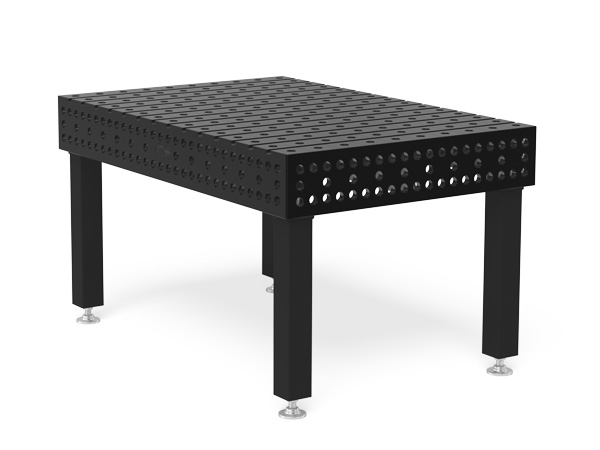
High-mix production facilities face a layout challenge that single-product manufacturers never encounter: every week brings new part geometries, different clamping requirements, and shifting throughput priorities. A fixed welding table layout optimized for one product mix becomes a liability when market demands shift. This is where the modular welding table approach transforms from a technical curiosity into a genuine competitive advantage. Understanding how to design, deploy, and scale modular welding table layouts is now essential knowledge for any fabrication manager navigating variable demand conditions.
What Makes a Layout Truly Modular
The word modular is applied loosely in welding equipment marketing, so it is worth establishing what genuine modularity means in this context. A truly modular welding table layout is built around standardized connection interfaces — typically precision-machined grid patterns with hole spacing of 50 mm or 100 mm — that accept interchangeable fixture elements. The grid itself is not simply holes drilled through a plate; it is a machined surface with positional tolerances of +/-0.05 mm or tighter, ensuring that any clamping fixture can be positioned accurately regardless of when or where it was manufactured.
Beyond the table surface, genuine modularity extends to the entire workstation ecosystem. Modular cable management arms, standardized tool holders, interchangeable fume extraction hoods, and consistently sized material staging racks all contribute to a workstation that can be reconfigured without redesign. The goal is that any trained fabricator can walk up to any modular welding table in the facility and immediately understand how to set up for any compatible fixture configuration.
Zoning Strategies for Multi-Product Layouts
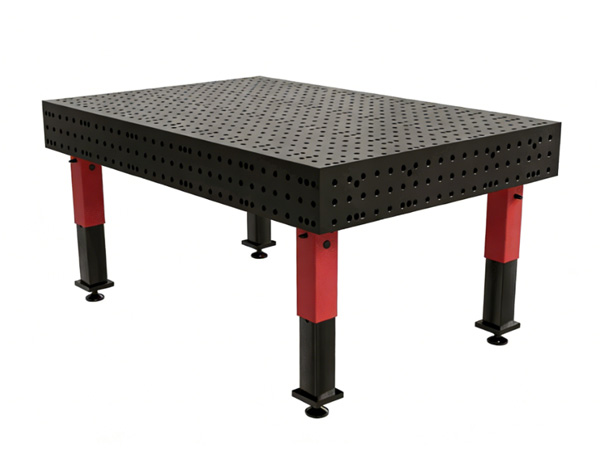
One of the most effective approaches to modular welding table layout in high-mix facilities is zoning — designating specific areas of the shop floor for different product families or process categories. Rather than trying to make every table equally suitable for every job, zoning allows the manufacturer to optimize specific zones for specific work types while maintaining the flexibility of the modular system.
A heavy structural zone might feature 2000 x 1000 mm modular tables with 30 mm plate surfaces and heavy-duty clamping packages rated to 3000 kg holding force. A precision assembly zone, by contrast, would use 1200 x 750 mm tables with finer grid spacing and precision levelling systems. An automation prep zone could feature tables with integrated robot mounting interfaces and automated clamping controls. Each zone serves its purpose optimally while sharing a common modular language.
Zoning also simplifies the operator decision-making process. When a new job arrives, the planner assigns it to the appropriate zone based on workpiece size, tolerance requirements, and production volume. The operator then selects the compatible fixture elements and configures the table within that zone's standardized framework. This structured flexibility dramatically reduces the time spent on job changeovers.
Scaling a Modular Layout: From One Table to a Production Line
Many facilities begin their modular journey with a single table and expand from there. This incremental approach is strategically sound because it allows the team to develop competence and refine procedures before committing larger capital. However, scaling effectively requires some advance planning even in the early stages.
When purchasing the first modular welding table, specify the grid pattern and clamping system that you intend to standardize on — not just for today, but for the anticipated two to three year horizon. Purchasing tables with different grid systems from different manufacturers creates incompatibility that undermines the modular concept. Committing to a single grid standard from day one means that fixture elements, spare parts, and operator training all compound in value as the number of tables grows.
Factory layouts should preserve 20 % to 30 % expansion space around modular tables for future additions. Routing power, grounding, extraction, and data cables in conduit rather than direct burial simplifies future table additions. A manufacturer who plans for six tables while initially purchasing three will save significantly compared to one who must retrofit infrastructure for every expansion step.
Workflow Optimization Through Layout Design
The physical arrangement of modular welding tables on the shop floor directly affects throughput, quality, and worker satisfaction. Applying lean manufacturing principles to the layout design process reveals opportunities that are invisible in conventional fixed-equipment arrangements.
Material flow analysis should precede any layout decision. Map the path each workpiece takes from raw material receipt through cutting, fitting, welding, and finishing. Position modular welding tables to minimize travel distances between sequential operations. In cell-based layouts where multiple stations are arranged in a U-shape, a fabricator can move between welding, fitting, and checking positions without leaving the work zone, reducing non-productive motion by 30 % to 40 % compared to traditional linear arrangements.
The distance between the modular welding table and raw material storage should be no more than a comfortable two-minute walk — any further and the operator accumulates idle time that adds up across hundreds of production runs per month. Similarly, completed weldments should flow directly to a designated out-bound staging area without crossing other material paths. Eliminating these intersection points reduces congestion and the risk of damage to finished work.
Integrating Digital Tools with Modular Layouts
Modern modular welding table layouts benefit enormously from digital integration. Tablet-based work order systems allow operators to pull up the fixture setup diagram for any product variant without leaving the workstation. RFID-tagged fixture elements can be automatically recognized by the table's control system, verifying that the correct fixture configuration is in place before production begins. This automation of setup verification is particularly valuable in regulated industries where documentation of correct configuration is a quality requirement.
Some advanced manufacturers link their modular fixture databases directly to their ERP systems. When a production order is released, the system automatically notifies the affected operator of the required fixture configuration and checks fixture availability against the current setup on each table. This closed-loop approach eliminates the class of quality escapes that occur when an operator runs a job with the wrong fixture mounted — a surprisingly common issue in high-mix environments with multiple active product variants.
Training and Standardization Across the Modular Fleet
The flexibility advantage of a modular welding table layout only materializes when the workforce is trained to use the system effectively. Developing standardized procedures for common fixture configurations, and ensuring that every operator follows those procedures, is as important as the physical equipment specifications.
A practical training program for modular welding table operation covers several competency areas. First, the operator must understand the grid system — how to read a fixture setup diagram, how to position and secure fixture elements correctly, and how to verify accuracy before beginning welding. Second, the training should cover the clamping philosophy — when to use which clamp type, how much torque to apply, and how to check for secure holding without over-constraining a workpiece in a way that induces residual stress.
Third, operators should be trained in the digital tools that support the modular system — how to access setup documentation, how to scan RFID tags for fixture verification, and how to report fixture condition issues through the maintenance system. Quarterly refresher training and annual competency assessments keep skills sharp and surface any gaps before they affect production quality.
Frequently Asked Questions
Q1: How many modular welding tables do I need to justify the modular approach in my facility?
There is no universal threshold, but facilities with three or more tables and more than eight different product configurations benefit most from full modular deployment. Even a single modular table delivers value if the shop frequently handles varied geometries — the fixture element investment pays off after three to four product changeovers. Above three tables, the fixture standardization benefits compound rapidly.
Q2: Should I standardize on 50 mm or 100 mm grid spacing for my modular welding table system?
For heavy fabrication with large workpieces and coarse tolerance requirements, 100 mm grid spacing provides adequate flexibility with more robust fixture elements. For precision work or small intricate components, 50 mm grid spacing offers finer positional adjustment. Some manufacturers offer dual-grid tables with both spacings, providing maximum flexibility in a single surface.
Q3: How do I plan the physical layout of modular welding tables to minimize workflow bottlenecks?
Begin with a material flow analysis mapping the path from raw material to finished product. Arrange tables in cell configurations that support sequential operations without backtracking. Preserve a minimum of 1200 mm access on at least two sides of each table. Locate tables near material staging and finished goods areas to minimize travel distance for operators and material handlers.
Q4: What digital tools should I integrate with my modular welding table layout?
Start with a digital work order and fixture documentation system accessible at the workstation. RFID fixture verification is valuable for regulated industries and high-mix environments with many active configurations. Integration with the maintenance management system for fixture condition tracking and scheduling. ERP connectivity for automatic fixture availability checking is the most advanced capability and the highest ROI for large fleets.
Q5: How often should fixture elements be inspected and maintained in a modular welding table fleet?
Fixture elements should be inspected weekly for wear, damage, and dimensional accuracy. Elements showing wear beyond tolerance should be removed from service and refurbished or replaced. Quarterly calibration of critical positioning elements against master reference artifacts maintains the accuracy chain across the entire fixture fleet. Annual inventory audits ensure that all elements are accounted for and in serviceable condition.
Conclusion
Designing a modular welding table layout for high-mix production is fundamentally an exercise in balancing standardization against flexibility. By committing to a common grid standard across the table fleet, applying zone-based layout principles that match table capabilities to product requirements, integrating digital tools that support setup accuracy and documentation, and investing in operator training that makes the modular system accessible to the entire workforce, fabrication managers can build workstation layouts that adapt to changing demand without requiring wholesale redesign. The facilities that master this approach gain a meaningful competitive edge in responsiveness and cost efficiency that is very difficult for competitors with rigid equipment layouts to replicate.
References
American Welding Society. (2023). Welding Handbook: Welding Processes Part 1 (10th ed.). Miami, FL: AWS.
Kalpakjian, S., & Schmid, S. R. (2021). Manufacturing Engineering and Technology (8th ed.). Pearson.
Chen, W., Williams, R., & Anderson, P. (2024). Flexible manufacturing strategies for high-mix fabrication environments. International Journal of Production Economics, 267, 108923.
Thompson, R., Lee, H., & Brown, M. (2023). Grid-based modular fixturing systems in precision fabrication. Journal of Manufacturing Systems, 69, 412-428.
-
Modular Welding Table Layout Strategies for High-Mix Production Facilities
-
Industrial Welding Table Applications in Mass Production Environments
-
Best Accessories to Upgrade Your Welding Table Performance
-
Heavy-Duty Welding Table for Shipbuilding Industry Guide
-
Efficient Welding Table Layout Design Guide for Industrial Shops
-
Steel Nitriding Welding Table: Benefits and Applications
Hebei Yongxin Measuring Tools
Copyright © 2025-2026 http://www.yx-weldingtable.com. All Rights Reserved Hebei Yongxin Measuring ToolsCopyright