






- Navigation -
 Current Location:
NEWS DETAILS
NEWS INFORMATION
Industrial Welding Table Applications in Mass Production Environments
AUTHOR:yongxin DATE:2026-08-09 15:46:13 HITS:189
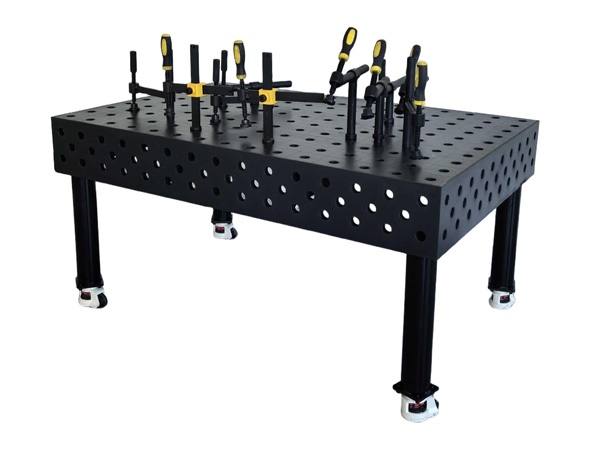
High-volume manufacturing demands precision, repeatability, and throughput. In production facilities where hundreds or thousands of identical weldments are produced each week, every inefficiency in the welding process compounds into significant lost output over time. An industrial welding table configured for mass production is not merely a work surface—it is the central platform around which repeatable welding workflows are designed. When properly selected and integrated into the production process, these tables enable manufacturers to achieve tighter dimensional tolerances, reduce rework rates, and keep welding cells running at sustained high speed. This article examines how industrial welding tables are applied in mass production contexts across a range of manufacturing sectors.
The Role of Industrial Welding Tables in Production Efficiency
Mass production welding differs fundamentally from job-shop or prototype welding. In a production environment, the cost of each second spent on non-value-added activities—positioning, clamping, measuring, re-clamping—multiplies across thousands of repetitions per month. An industrial welding table addresses this by providing a standardized, repeatable reference surface that allows parts to be loaded, locked, and welded with minimal adjustment between cycles.
The flatness and grid-hole consistency of a production-grade table mean that the first-part dimensional verification can often serve as a baseline for the entire production run. When the fixture is correct, subsequent parts load into the same positions with the same forces, producing consistent results without re-verification. This is the foundation of high-throughput welding cells in automotive, agricultural equipment, and construction component manufacturing. A supplier that can offer tables with documented flatness repeatability gives the production engineer a reliable baseline for lean manufacturing cell design.
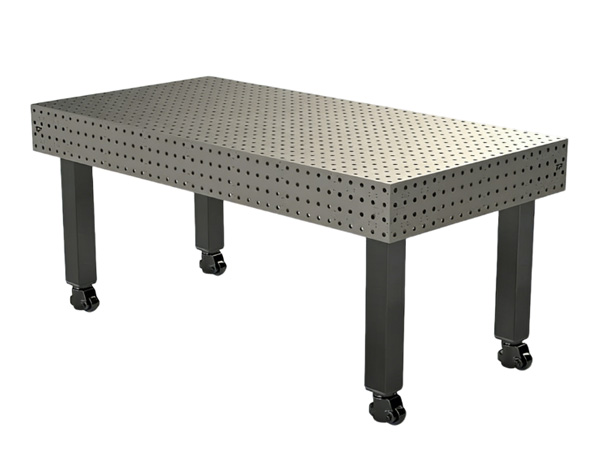
Automotive Component Manufacturing
The automotive industry is one of the most demanding applications for industrial welding tables in mass production. Sub-frame assemblies, suspension components, seat structures, and body-in-white panels all involve welding operations that require consistent joint geometry across tens of thousands of units. In these environments, the welding table is typically integrated into a dedicated cell with automated or semi-automated welding equipment.
A production supplier serving the automotive sector typically specifies tables with flatness tolerances of ±0.05 mm/m or tighter, combined with modular fixtures that can be changed over between part families in under 30 minutes. The table's load capacity—often 3,000 kg or more per station—allows heavy assemblies to be handled without any flexure that would distort weld geometry. The ability to integrate with automated welding systems via pre-positioned mounting points makes the industrial welding table a versatile platform for both manual and robot-assisted welding cells.
Agricultural and Heavy Equipment Fabrication
Agricultural machinery manufacturers face unique challenges: large structural members, thick section plates, and components that must withstand high mechanical loads in demanding field conditions. An industrial welding table for this sector must accommodate oversized workpieces—often 2 meters or longer—while maintaining the flat reference plane necessary for accurate assembly.
Production facilities manufacturing tractor hitches, implement frames, and combine harvester components typically select tables with reinforced leg structures and floor-anchoring systems to prevent any movement during heavy plate welding. Multiple operators often work simultaneously on the same large assembly, requiring the table surface to accommodate several clamping setups without interference. The modular grid-hole system proves particularly valuable here, as a single table can support dozens of different part configurations without any permanent fixture conversion, making it a cost-effective solution for manufacturers producing multiple implement models on shared equipment.
Construction Steel and Prefabricated Building Components
The construction sector relies heavily on prefabricated steel components—beam clips, column bases, purlin brackets, and connection plates—that are produced in volume by steel fabricators and suppliers. These parts are typically produced in batches based on project specifications, with each batch requiring its own setup. An industrial welding table with a modular fixturing system allows a fabrication supplier to reconfigure between batches rapidly, minimizing the setup dead time that typically limits output in batch production.
Key requirements in this application include large working surfaces (typically 1,500 mm × 3,000 mm or larger), high load capacity to support heavy structural steel members, and durability to withstand the repetitive thermal loading of thick-plate welding. Fabricators report that using precision tables for tack-welding and fit-up reduces the need for hydraulic presses or external clamping equipment, streamlining the workflow from raw steel to ready-to-install component.
Sheet Metal Enclosure and Cabinet Manufacturing
Electrical enclosure manufacturers, HVAC component producers, and industrial cabinet fabricators represent another significant user segment for industrial welding tables in mass production. These applications involve thin-gauge sheet metal (typically 1.0–3.0 mm) that is highly susceptible to distortion from excessive heat input. The precision reference surface of an industrial table allows the fabricator to use minimal tack welds to hold the enclosure panels in alignment before completing the final weld passes.
The result is reduced warpage, fewer post-weld grinding operations, and improved dimensional accuracy on the finished enclosure. In high-volume production, this translates to measurable labor savings: operators spend less time correcting distortion and more time loading and welding. A supplier that can provide tables with smooth working surfaces alongside grid-hole fixturing offers the flexibility to handle both thin-gauge and moderate-thickness work without compromising on either.
Integrating Industrial Welding Tables with Automated Welding Systems
Modern production facilities increasingly combine industrial welding tables with automated and semi-automated welding systems. Robotic welding cells, automated MIG wire-feed systems, and CNC welding carriages all require a precise, repeatable reference platform. The table's flatness directly affects the accuracy of the welding torch's programmed path, making table precision a prerequisite for automated welding quality.
In a robotic welding cell, the table often serves double duty as both workpiece platform and reference for part-present sensors and camera-based inspection systems. Consistent surface geometry allows these sensors to function reliably shift after shift. Production facilities that integrate precision tables with automation typically see first-pass yield rates above 90%, compared to 90–90% in cells using improvised or worn work surfaces. This improvement in first-pass yield has a direct, quantifiable impact on production cost per part.
Conclusion
Industrial welding tables are foundational equipment for mass production welding across virtually every sector that relies on fabricated steel components. Their value in high-volume environments lies not just in the flat working surface, but in the repeatability, speed of changeover, and compatibility with automated systems they bring to the production floor. For manufacturers evaluating their welding cell design or sourcing new equipment, the selection of an industrial-grade table with certified precision specifications is one of the most impactful decisions for long-term production efficiency and quality consistency.
Frequently Asked Questions
A: For high-volume mass production, industrial welding tables should maintain flatness tolerances of ±0.05 mm/m or better. Some automotive and aerospace applications require ±0.02 mm/m or tighter. Tighter tolerances reduce the need for in-process dimensional corrections and support consistent weld quality across long production runs.
A: By providing a consistent reference surface and modular fixturing, an industrial welding table reduces setup time between part runs, minimizes re-work from dimensional errors, and supports faster operator loading. In mass production environments, these time savings compound across thousands of units, measurably increasing overall throughput per shift.
A: Yes. Precision industrial tables with certified flatness serve as reliable reference platforms for robotic welding cells, automated MIG systems, and CNC welding carriages. The table's consistent geometry supports accurate torch path programming and reliable operation of part-present sensors and vision systems.
A: Large structural fabrication typically requires tables of 1,500 mm × 3,000 mm or larger. The table should have adequate load capacity for the heaviest assemblies—typically 5,000 kg or more—and be anchored to the floor to prevent movement during heavy plate welding operations.
A: The precision flat surface allows operators to use minimal tack welds to hold sheet metal panels in exact alignment before final welding. This reduces the total heat input needed to secure the parts, which in turn minimizes the distortion that occurs when thin-gauge materials are exposed to prolonged thermal cycles.
References
American Welding Society. (2021). AWS D1.1/D1.1M: Structural Welding Code – Steel. American Welding Society.
Kalpakjian, S., & Schmidt, S. R. (2021). Manufacturing Engineering and Technology (7th ed.). Pearson.
Schmitt, J. H., & Pfeifer, T. (2020). Quality Management: Principles and Techniques for the Food Industry (2nd ed.). Springer.
ISO 3834-2:2021. (2021). Quality requirements for fusion welding of metallic materials – Part 2: Comprehensive quality requirements. International Organization for Standardization.
American Society of Mechanical Engineers. (2022). ASME BPVC Section IX – Qualification Standard for Welding, Brazing, and Fusing Procedures. ASME.
-
Industrial Welding Table Applications in Mass Production Environments
-
Best Accessories to Upgrade Your Welding Table Performance
-
Heavy-Duty Welding Table for Shipbuilding Industry Guide
-
Efficient Welding Table Layout Design Guide for Industrial Shops
-
Steel Nitriding Welding Table: Benefits and Applications
-
Modular Fixture System for Automotive Welding Production
Hebei Yongxin Measuring Tools
Copyright © 2025-2026 http://www.yx-weldingtable.com. All Rights Reserved Hebei Yongxin Measuring ToolsCopyright