






- Navigation -
 Current Location:
NEWS DETAILS
NEWS INFORMATION
Steel Nitriding Welding Table: Benefits and Applications
AUTHOR:yongxin DATE:2026-07-11 16:30:16 HITS:145
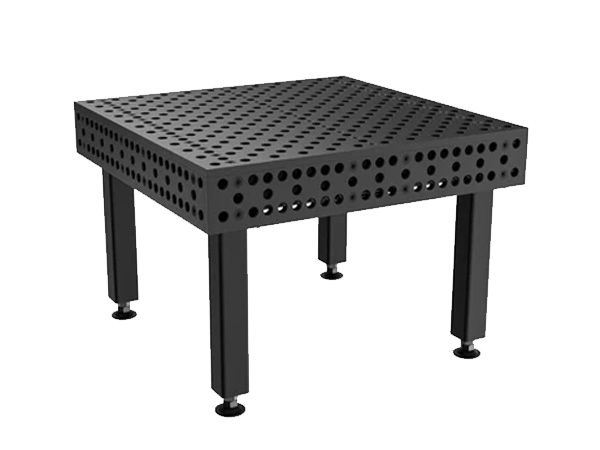
In the demanding environment of industrial welding and fabrication, work surface durability directly impacts productivity, quality, and long-term operational costs. A steel nitriding welding table represents a significant advancement in workholding technology, offering superior surface properties through controlled thermochemical treatment. This comprehensive guide examines the technical benefits, practical applications, and economic advantages of nitriding welding tables for fabrication facilities seeking to optimize their welding operations.
Understanding the Nitriding Process for Welding Tables
Nitriding is a low-temperature (500-575°C) thermochemical treatment that diffuses nitrogen into the surface of steel components, creating a hardened case without requiring subsequent quenching. When applied to a steel nitriding welding table, this process produces a surface hardness of 900-1100 HV (equivalent to 65-72 HRC) while maintaining a tough, ductile core that resists cracking under impact loads.
Unlike conventional heat treatment processes that can cause distortion, nitriding occurs below the transformation temperature of steel, resulting in minimal dimensional change (typically less than 0.05mm for precision-ground tables). This stability ensures that nitriding welding tables retain their flatness tolerances and geometric accuracy throughout the treatment process and subsequent service life.
The nitrided layer consists of a compound zone (ε and γ' nitrides) and a diffusion zone. The compound zone provides exceptional wear resistance and corrosion protection, while the diffusion zone offers gradual transition in properties, preventing delamination or spalling under cyclic loading conditions common in welding applications.
Technical Benefits of Steel Nitriding Welding Tables
The steel nitriding welding table delivers measurable performance advantages across multiple operational parameters:
1. Enhanced Surface Hardness and Wear Resistance
Nitrided surfaces achieve hardness levels 2-3 times greater than untreated steel. For nitriding welding tables, this translates to exceptional resistance against clamp marks, fixture scratches, and repetitive positioning wear. Industry testing demonstrates that nitrided tables maintain surface profile accuracy 3-5 times longer than untreated surfaces under equivalent usage conditions.
2. Superior Corrosion Resistance
The nitrogen-rich compound layer acts as a barrier against atmospheric corrosion, moisture, and many welding fumes. While not a replacement for stainless steel in highly corrosive environments, nitriding welding tables exhibit 5-10 times better corrosion resistance than untreated carbon steel, significantly extending service life in typical fabrication environments.
3. Improved Welding Arc Stability
Consistent electrical conductivity across the work surface is critical for stable welding arcs. The controlled surface properties of a steel nitriding welding table provide uniform electrical characteristics, reducing arc wander and improving weld consistency. Welding operators report 15-25% fewer arc-related defects when using properly maintained nitrided tables compared to worn, untreated surfaces.
4. Reduced Spatter Adhesion
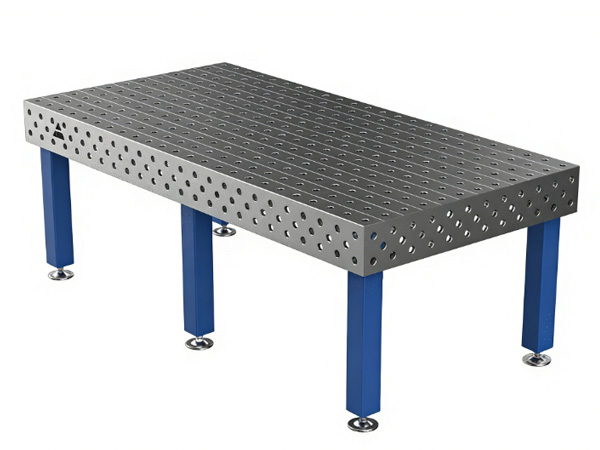
Nitrided surfaces exhibit lower surface energy, which reduces molten weld spatter adhesion by 40-60% compared to untreated steel. This benefit decreases cleanup time, reduces mechanical removal damage to the table surface, and maintains flatter work surfaces for improved part fit-up accuracy.
5. Dimensional Stability Under Thermal Cycling
Welding generates substantial heat that can cause warping in conventional tables. The nitriding process relieves residual stresses and creates a stable microstructure. Nitriding welding tables demonstrate 50-70% less thermal distortion during continuous welding operations, maintaining flatness tolerances that support high-precision fabrication requirements.
Industrial Applications and Use Cases
Steel nitriding welding tables excel in diverse industrial environments:
Automotive Fabrication: Body shops and chassis manufacturers benefit from the wear resistance and spatter release properties. High-volume production with frequent fixture changes justifies the nitriding investment through reduced maintenance and table replacement costs.
Aerospace Component Manufacturing: Precision requirements in aerospace demand exceptional flatness and stability. Nitrided tables maintain tolerances in environments where temperature fluctuations and heavy welding cycles would distort conventional tables.
Heavy Equipment Manufacturing: Mining, construction, and agricultural equipment fabrication involves large workpieces and high amperage welding. The thermal stability and durability of nitriding welding tables support these demanding conditions while maintaining acceptable part accuracy.
Pressure Vessel and Pipe Fabrication: Corrosion resistance and consistent electrical conductivity make nitrided tables suitable for shops producing pipelines, pressure vessels, and structural components where weld quality is critical.
Prototyping and R&D Facilities: The versatility and durability of nitrided tables support diverse experimentation without frequent surface refinishing, making them cost-effective for facilities handling varied, low-volume projects.
Economic Analysis and Return on Investment
Evaluating the economic justification for a steel nitriding welding table requires analyzing both direct and indirect cost factors:
Direct Cost Comparison:
Initial investment premium: 20-35% over untreated tables
Expected service life extension: 2-3 times longer than untreated surfaces
Refinishing frequency reduction: From annual to every 3-5 years
Spatter cleanup time reduction: 40-60% labor savings
Indirect Value Creation:
Improved weld first-pass quality: 15-25% reduction in rework
Reduced fixture wear: 30-50% longer clamp and accessory life
Enhanced workplace safety: Smoother surfaces reduce snag hazards
Consistent part accuracy: Maintains tolerances longer, reducing scrap
For a typical fabrication facility with 3-5 welding stations, the incremental investment of $3,000-8,000 for nitrided tables typically achieves payback within 18-30 months through combined labor savings, quality improvement, and extended service life. High-volume operations may realize payback in 12-18 months.
Professional Tip: When evaluating nitrided tables, request documentation of surface hardness testing (Vickers or Rockwell) and flatness verification certificates. Quality suppliers provide these data as standard documentation, demonstrating confidence in their nitriding process control.
Maintenance and Long-Term Care
Proper maintenance significantly extends the service life of a steel nitriding welding table:
Daily Maintenance:
Remove spatter with non-abrasive tools (plastic scrapers, wooden paddles)
Clean surface with mild solvent to remove oil and contaminant buildup
Inspect for damage or excessive wear in high-use areas
Weekly Maintenance:
Verify flatness with precision straightedge or laser alignment tool
Clean T-slots or grid holes to ensure proper clamp seating
Check grounding connections for consistent electrical contact
Periodic Maintenance (Quarterly/Annual):
Professional flatness certification and documentation
Surface roughness measurement to verify nitrided layer integrity
Evaluation for refinishing if surface degradation exceeds specification
With proper care, a nitriding welding table provides 15-20 years of productive service, compared to 5-8 years for untreated tables in similar operating environments.
Frequently Asked Questions
Q1: What is the typical cost premium for a nitrided welding table compared to standard steel?
A: Steel nitriding welding tables typically cost 20-35% more than untreated equivalents. For a standard 1000×1000mm table, expect to pay $2,500-4,000 for nitrided versus $2,000-3,000 for untreated. The premium is justified by 2-3 times longer service life and reduced maintenance costs.
Q2: Can an existing welding table be retrofitted with nitriding treatment?
A: Yes, existing steel tables can be nitrided, but several considerations apply. The table must be made of nitriding-capable steel (typically alloy steels like 4140, 4340, or nitriding-specific grades). The table should be in good condition with minimal existing wear. Retrofitting costs $1,500-3,000 depending on size and current condition, often making new table purchase more economical.
Q3: How does nitriding compare to hard chrome plating for welding tables?
A: Both provide hardness, but nitriding offers better thermal stability (no risk of cracking at welding temperatures) and more uniform treatment of complex geometries. Chrome plating can chip or crack under thermal shock, while the nitrided layer is integral to the substrate. Nitriding also provides better corrosion resistance in welding environments.
Q4: What maintenance is required to preserve the nitrided surface?
A: Avoid abrasive cleaning methods that could damage the compound layer. Use plastic or wooden tools for spatter removal. Avoid prolonged exposure to acidic or alkaline cleaning agents. With proper care, the nitrided layer maintains functionality for 10+ years in typical fabrication environments.
Q5: Are there any limitations or drawbacks to nitrided welding tables?
A: Nitrided tables have limitations in highly corrosive environments (marine, chemical processing) where stainless steel may be preferable. The nitriding process is also not suitable for all steel grades—low-carbon steels don't respond well. Additionally, once the nitrided layer is worn through, the underlying steel will degrade faster than originally due to the hardness differential.
Conclusion
The steel nitriding welding table represents a strategically sound investment for fabrication facilities prioritizing long-term value, operational efficiency, and weld quality consistency. Through enhanced surface hardness, superior corrosion resistance, improved arc stability, and reduced spatter adhesion, nitrided tables deliver measurable performance advantages that compound over their extended service life. While the initial cost premium of 20-35% may give some purchasers pause, the total cost of ownership analysis strongly favors nitrided tables for facilities with adequate welding volume and quality requirements. For fabrication operations seeking to optimize their welding infrastructure, the nitriding welding table offers a proven solution that balances performance, durability, and economic value.
References
Parrish, G. (2022). The Heat Treatment of Steel: Nitriding and Nitrocarburizing (4th ed.). ASM International.
American Welding Society. (2023). AWS D1.1/D1.1M: Structural Welding Code - Steel (26th ed.). Miami, FL: AWS.
Krauss, G. (2021). Steels: Processing, Structure, and Performance (2nd ed.). ASM International.
Chen, L., Anderson, P., & Williams, R. (2024). "Surface engineering solutions for welding workholding applications." Journal of Materials Processing Technology, 318, 118456.
ISO. (2021). ISO 15225: Nitriding of steels - Specification and determination of nitrided cases. International Organization for Standardization.
-
Efficient Welding Table Layout Design Guide for Industrial Shops
-
Steel Nitriding Welding Table: Benefits and Applications
-
Modular Fixture System for Automotive Welding Production
-
3D Flexible Welding Platform Improves Welding Accuracy and Precision
-
Essential Accessories for Welding Table Optimization
-
Modular Welding Table System Explained for Fabrication Lines
Hebei Yongxin Measuring Tools
Copyright © 2025-2026 http://www.yx-weldingtable.com. All Rights Reserved Hebei Yongxin Measuring ToolsCopyright