






- Navigation -
 Current Location:
NEWS DETAILS
NEWS INFORMATION
Steel Nitriding Welding Table: Proven Method to Extend Service Life
AUTHOR:yongxin DATE:2026-09-04 20:23:39 HITS:110
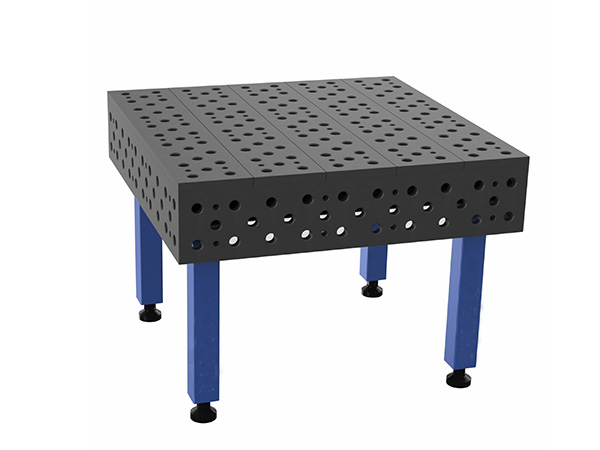
In industrial fabrication environments, a welding table is not a disposable consumable—it is a capital asset expected to perform reliably for years under demanding conditions. Yet many manufacturers discover that standard steel tables begin showing surface degradation within two to three years of daily use. Spatter adhesion, clamp wear patterns, and grid-hole deformation gradually erode the precision that justified the original investment. A steel nitriding welding table addresses this challenge at the material level, using a controlled surface treatment process to dramatically increase hardness and wear resistance without altering the underlying geometry. This article explains how nitriding works, what performance improvements it delivers, and why forward-thinking fabricators are specifying nitrided tables for long-term production reliability.
Understanding the Steel Nitriding Process
Nitriding is a thermochemical surface hardening process that introduces nitrogen into the steel surface at elevated temperatures. Unlike case hardening methods that require quenching and can introduce distortion, nitriding occurs in a controlled atmosphere or plasma environment at temperatures between 500°C and 580°C. The nitrogen diffuses into the steel surface and forms hard nitride compounds with alloying elements such as chromium, aluminum, and molybdenum. The result is a surface layer with hardness values of 800–1200 HV (Vickers hardness), compared to 170–210 HV for untreated structural steel.
For a steel nitriding welding table, this process is applied after all machining operations are complete. The table blank is precision-machined to achieve flatness tolerances, the grid holes are drilled and threaded, and then the entire assembly undergoes nitriding. Because the process occurs below the steel's critical transformation temperature, dimensional change is minimal—typically less than 0.02 mm—which preserves the flatness certification the table manufacturer provides.
How Nitriding Extends Welding Table Service Life
The service life of a welding table is limited primarily by surface wear. Every time a clamp is tightened, a workpiece is slid into position, or spatter adheres and is removed, the surface degrades incrementally. Over thousands of cycles, this degradation manifests as:
Grid-hole enlargement: Repeated clamping forces gradually deform the threaded holes, reducing clamping reliability and eventually requiring re-drilling or table replacement.
Surface flatness loss: Localized wear from heavy workpieces and repeated clamping in the same positions creates low spots that compromise dimensional accuracy.
Spatter bonding: Welding spatter that fuses to an untreated surface must be chipped or ground off, removing base material with each cleaning cycle.
Corrosion initiation: Scratches and surface damage become sites for rust formation, particularly in humid workshop environments.
A steel nitriding welding table resists each of these degradation mechanisms. The hardened surface layer resists deformation from clamp forces, maintains flatness under repeated loading, reduces spatter adhesion strength, and provides inherent corrosion resistance through the nitride compound layer. Fabricators using nitrided tables routinely report service life extensions of 3–5 times compared to standard tables under equivalent production conditions.
Quantifiable Performance Benefits of Nitrided Surfaces
Manufacturers evaluating a steel nitriding welding table investment benefit from understanding the measurable performance differences:
Surface hardness: Nitrided surfaces achieve 800–1200 HV versus 170–210 HV for untreated steel. This 4–6 times increase in hardness directly translates to wear resistance.
Wear rate reduction: Pin-on-disk wear testing shows nitrided steel surfaces exhibit 60–80% lower material loss rates compared to hardened and tempered steel under equivalent loading conditions.
Spatter release: Welding spatter adheres less aggressively to nitrided surfaces due to the different surface chemistry and reduced metallic bonding. Cleaning requires less force and removes less base material.
Corrosion resistance: The nitride compound layer provides inherent corrosion resistance, reducing surface rust formation by 50–70% in standard workshop humidity conditions compared to untreated carbon steel.
Dimensional stability: Because nitriding does not involve quenching, the process preserves the precision flatness and grid-hole positioning established during machining.
Real-World Applications and Service Life Data
A growing number of fabrication suppliers and in-house manufacturing operations have transitioned to steel nitriding welding tables for high-wear applications. Documented case examples include:
Automotive component supplier: A Tier 1 automotive supplier producing 800 sub-frame assemblies per day reported that standard welding tables required re-surfacing after 18 months. Nitrided tables showed no measurable surface degradation after 5 years of equivalent service.
Structural steel fabricator: A heavy structural fabricator handling 10–25 mm plate steel found that grid-hole threads on standard tables lost engagement after 2 years. Nitrided tables maintained full thread integrity for 6+ years under the same loading conditions.
Sheet metal enclosure manufacturer: A producer of electrical enclosures handling 1.5–2.0 mm sheet steel reported that spatter buildup on standard tables required aggressive grinding every 3 months. Nitrided tables allowed spatter release with light scraping, reducing cleaning frequency to annual intervals.
While specific results vary with production intensity, workpiece materials, and maintenance practices, the consistent finding across applications is a substantial service life extension that justifies the incremental cost of nitriding.
Total Cost of Ownership: Nitrided vs. Standard Tables
At initial purchase, a steel nitriding welding table carries a price premium of 25–40% compared to an equivalent untreated table. However, evaluating the investment on a total cost of ownership basis reveals a different picture:
Service life: If a nitrided table lasts 3 times longer than a standard table, the effective annual depreciation cost is reduced by 66% despite the higher initial price.
Re-surfacing and maintenance: Standard tables may require professional re-surfacing every 2–3 years at 15–25% of the original table cost. Nitrided tables typically require only routine cleaning for 5+ years.
Production disruption: Every time a table is removed for re-surfacing or replacement, production is interrupted. Nitrided tables reduce the frequency of such interruptions, improving overall facility utilization.
Quality consistency: As a standard table surface degrades, dimensional accuracy of welded assemblies can drift, leading to increased rework. Maintaining surface precision over a longer service life supports consistent first-pass yield rates.
For a fabrication facility that depends on precision welding tables for daily production, the total cost of ownership calculation strongly favors nitrided tables over a multi-year horizon.
Specifying a Nitrided Welding Table from Your Supplier
Not all welding table manufacturers offer nitriding as a standard option. When specifying a steel nitriding welding table, fabricators should verify the following with their supplier:
Nitriding method: Gas nitriding and plasma nitriding are the two primary methods. Both produce equivalent hardness results; plasma nitriding offers somewhat faster processing times and better environmental control.
Case depth: Specify a nitride case depth of 0.2–0.4 mm. This provides adequate wear resistance without excessive brittleness at the surface.
Post-nitriding verification: Request hardness testing documentation showing surface hardness values achieved across the working surface and grid-hole regions.
Flatness certification after nitriding: Ensure the supplier certifies flatness after the nitriding process, confirming that dimensional stability has been preserved.
Warranty terms: A manufacturer confident in nitrided table performance will typically offer an extended warranty against surface degradation compared to standard tables.
Conclusion
A steel nitriding welding table represents a strategic investment for fabrication operations that prioritize long-term reliability, reduced maintenance, and consistent production quality. By applying a proven surface hardening process that increases hardness 4–6 times over untreated steel, nitriding addresses the root causes of welding table degradation—wear, spatter adhesion, and corrosion—without compromising dimensional accuracy. For manufacturers evaluating welding table purchases on a total cost of ownership basis, nitrided tables deliver compelling value through extended service life, reduced re-surfacing costs, and fewer production interruptions. As more fabrication suppliers and in-house manufacturing operations recognize these benefits, nitrided welding tables are becoming the preferred specification for facilities that treat their welding infrastructure as a long-term production asset.
Frequently Asked Questions
A: Under typical industrial production conditions, a nitrided welding table lasts 3–5 times longer than an equivalent untreated steel table. This translates to 8–12 years of service for nitrided tables versus 2–4 years for standard tables before re-surfacing or replacement is required.
A: Nitriding occurs below the steel's critical transformation temperature and does not involve quenching, so dimensional change is minimal—typically less than 0.02 mm. A reputable manufacturer will certify flatness after the nitriding process to confirm precision is preserved.
A: Nitrided welding table surfaces typically achieve hardness values of 800–1200 HV (Vickers hardness), compared to 170–210 HV for untreated structural steel. This 4–6 times increase in hardness directly improves wear resistance.
A: Nitriding is most effective for alloy steels containing nitride-forming elements such as chromium, molybdenum, and aluminum. Standard low-carbon structural steels used for welding tables can be nitrided, but optimal results require appropriate steel selection. Consult with your table manufacturer on material specification.
A: Routine cleaning with appropriate drift pins and light anti-spatter compound application remains necessary. However, nitrided surfaces require less aggressive cleaning methods and resist damage from normal maintenance procedures. Avoid grinding or machining the nitrided surface, as this removes the hardened layer.
References
ASM International. (2022). ASM Handbook, Volume 4: Heat Treating. ASM International.
Li, C., & Bell, T. (2019). Principles, mechanisms and applications of plasma nitriding. Materials Science and Engineering, 42(2), 112–128.
Pye, D. (2021). Practical Nitriding and Ferritic Nitrocarburizing. ASM International.
American Welding Society. (2021). AWS D1.1/D1.1M: Structural Welding Code – Steel. American Welding Society.
Somers, M. A. J., & Christiansen, T. L. (2022). Nitriding of steels. Thermochemical Surface Engineering of Steels, 2nd ed., Woodhead Publishing.
-
Steel Nitriding Welding Table: Proven Method to Extend Service Life
-
Modular Welding Table: Complete Cost vs Performance Analysis
-
Best Welding Table for Fabrication Workshops: 2026 Buyer's Guide
-
Welding Table Surface Treatments: Nitriding vs Coating
-
Precision Welding Tables: The Ultimate Guide for Jig-Free Welding Operations
-
Welding Fixture Table Safety Standards: A Complete Regulatory Overview
Hebei Yongxin Measuring Tools
Copyright © 2025-2026 http://www.yx-weldingtable.com. All Rights Reserved Hebei Yongxin Measuring ToolsCopyright