






- Navigation -
 Current Location:
NEWS DETAILS
NEWS INFORMATION
Modular Welding Table: Complete Cost vs Performance Analysis
AUTHOR:yongxin DATE:2026-09-01 20:15:01 HITS:173
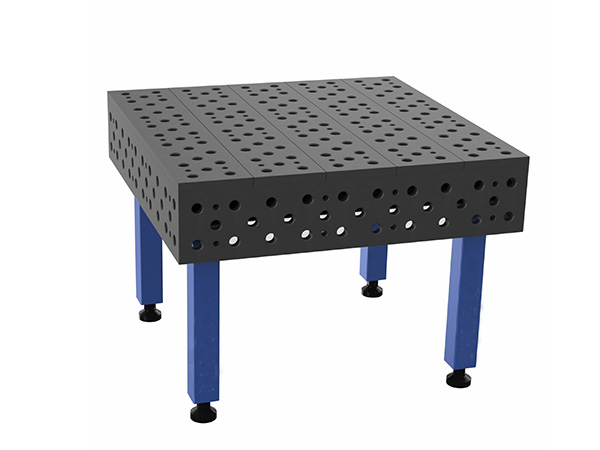
When fabrication shops and manufacturing facilities evaluate equipment investments, the conversation often centers on initial purchase price. For a modular welding table, however, the initial price tells only part of the story. The true value of a modular fixturing system lies in its ability to reduce setup time, eliminate custom jig fabrication costs, and improve consistency across production runs. This article provides a detailed cost versus performance analysis for modular welding tables, examining initial investment levels, measurable productivity gains, and total cost of ownership over the equipment's service life. By understanding these factors, manufacturers can make purchasing decisions based on long-term value rather than short-term price alone.
Understanding the Cost Structure of Modular Welding Tables
The total cost of acquiring a modular welding table system includes several components beyond the table surface itself:
Base table cost: The precision-machined flat surface with grid holes represents 60–70% of the total system investment. Prices vary with size, flatness tolerance, and surface treatment. A standard 1,200 mm × 2,400 mm precision table typically ranges from $2,500 to $5,000 depending on manufacturer and specifications.
Clamping and fixturing accessories: A comprehensive accessory kit—step clamps, flat clamps, stops, angle plates, and V-blocks—adds 15–25% to the table cost. This is not optional; a table without accessories is simply a flat plate.
Support structure and mobility: Leg assemblies, floor anchors, and rolling base options add 10–20% to the base table cost. Heavy-duty configurations for structural steel work command premium pricing.
Surface treatment upgrades: Nitriding, plasma hardening, or specialized coatings add 25–40% to the base table price but significantly extend service life.
Training and integration: Operator training on modular fixturing techniques and workflow integration may require 8–16 hours of non-productive time during implementation.
A fully equipped modular welding table system for a professional fabrication shop typically represents an investment of $4,000–$8,000 for a standard configuration, with heavy-duty or treated-surface systems exceeding $10,000.
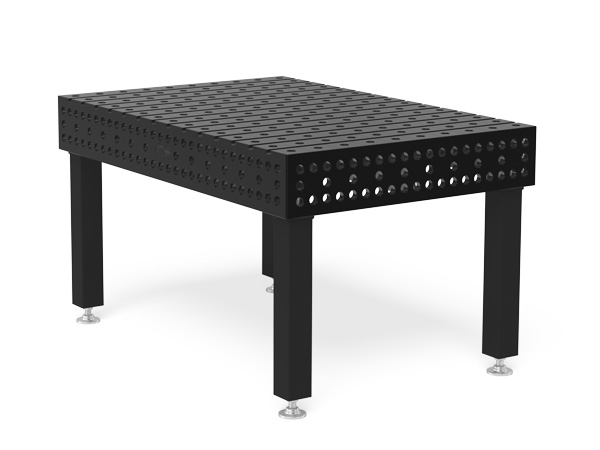
Performance Metrics: What Modular Tables Deliver
To evaluate whether the cost is justified, it is necessary to quantify the performance improvements a modular welding table provides. Documented performance metrics from production facilities include:
Setup time reduction: Facilities transitioning from custom jigs to modular fixturing report 40–70% reductions in setup time between part configurations. A setup that previously required 2–3 hours to build a custom jig can often be accomplished in 30–45 minutes with modular components.
Jig fabrication cost elimination: Custom jigs for complex geometries can cost $500–$5,000 each and require days to fabricate. A modular table eliminates most custom jig requirements, converting a variable cost into a fixed capital investment.
Improved first-pass yield: Consistent fixturing reduces dimensional errors caused by jig wear or misalignment. Production facilities report 2–5% improvements in first-pass yield after implementing precision modular tables.
Reduced rework and scrap: Dimensional accuracy achieved through precision fixturing reduces the need for post-weld correction. Shops report 15–30% reductions in rework labor for assemblies fixtured on modular tables.
Storage space savings: Eliminating a library of custom jigs frees floor space. A medium-sized job shop might previously store 50–100 jigs; modular tables consolidate this into a single platform.
Comparing Modular Tables to Traditional Fixturing Approaches
A meaningful cost-performance analysis requires comparison with the alternative: traditional jig-based fixturing. Consider a fabrication shop that produces 12 different part families per year, each requiring a custom fixture:
Traditional approach: 12 custom jigs at an average cost of $1,500 each = $18,000 in fixture costs per year. Additional storage space for jigs, fabrication labor for jig construction, and lead time delays when new jigs are required.
Modular table approach: One-time investment of $6,000 in a modular welding table and accessories. Reconfiguration between part families takes 30–60 minutes using existing components. No ongoing jig fabrication costs, no storage burden, and immediate availability for new part geometries.
Under this scenario, the modular table achieves cost parity within the first year. Over a five-year service life, the modular approach saves $70,000–$80,000 in jig fabrication costs compared to traditional fixturing—before accounting for setup time reductions and quality improvements.
Total Cost of Ownership Over Equipment Service Life
A comprehensive modular welding table cost analysis must account for the full ownership cycle:
Initial acquisition cost: $4,000–$10,000 for a fully equipped system, depending on size, specifications, and surface treatment.
Maintenance costs: Routine cleaning, grid-hole maintenance, and occasional flatness verification. Annual maintenance costs typically range from $100–$300 for cleaning supplies and professional inspection.
Resurfacing or refurbishment: Standard tables may require professional resurfacing every 3–5 years at 15–25% of the original table cost. Nitrided or hardened surfaces extend this interval to 7–10 years.
Accessory replacement: Clamping components and accessories experience wear and may require periodic replacement. Budget 5–10% of accessory cost annually for replacement of worn items.
End-of-life value: Quality modular tables from reputable manufacturers retain resale value. A well-maintained table may command 30–50% of its original price on the used equipment market after 8–10 years.
When these factors are combined, the annual cost of owning a modular welding table typically ranges from $600–$1,200 depending on configuration and maintenance practices—a fraction of the annual jig fabrication and setup labor costs the table replaces.
Quantifying Return on Investment for Fabrication Operations
Calculating the return on investment for a modular welding table requires identifying the specific cost centers it affects:
Setup labor savings: If a shop performs 200 setups per year and reduces each setup by an average of 90 minutes, the annual labor savings at $45/hour fully loaded labor cost equals $13,500.
Jig fabrication elimination: If the shop previously fabricated 15 custom jigs per year at an average cost of $1,800, annual savings equal $27,000.
Rework reduction: If improved fixturing reduces rework from 8% to 4% of production volume on 500 assemblies per year at $50 average rework cost, annual savings equal $10,000.
Lead time improvement: Faster setup and elimination of jig fabrication lead times may enable the shop to take on additional work. While difficult to quantify precisely, this capacity improvement represents real revenue potential.
Under these typical conditions, a modular welding table investment of $7,000 generates annual savings of $40,000–$50,000, achieving payback within 2–3 months and delivering 500–700% ROI over a five-year service life.
Factors That Influence Cost-Performance Outcomes
Not every facility achieves identical results. The actual cost-performance relationship of a modular welding table depends on several factors:
Production diversity: Facilities with high part mix and frequent changeovers benefit most. A dedicated high-volume line producing one part continuously gains less from modular flexibility.
Existing fixturing approach: Shops already using custom jigs see immediate savings. Shops using improvised or no fixturing may not recognize the cost comparison as clearly.
Operator skill and training: Modular fixturing is a technique as much as a tool. Operators trained in efficient setup strategies achieve better results than those left to figure out the system independently.
Accessory selection: A table with too few clamping and positioning components limits flexibility. Over-investing in rarely used accessories wastes capital. Matching the accessory kit to actual production needs optimizes cost-effectiveness.
Conclusion
A modular welding table represents one of the highest-return investments available to fabrication shops and manufacturing facilities. While the initial cost of $4,000–$10,000 for a fully equipped system exceeds basic work surface options, the performance benefits—setup time reduction, jig fabrication elimination, quality improvement, and storage consolidation—generate annual savings that typically exceed the entire initial investment. When evaluated on a total cost of ownership basis over a five-year service life, modular welding tables deliver ROI that few other equipment investments can match. For fabricators and manufacturers seeking to improve productivity without expanding workforce or facility footprint, a modular welding table is not an expense—it is a strategic investment with measurable, rapid payback.
Frequently Asked Questions
A: Under typical fabrication shop conditions with diverse part mix and frequent changeovers, a modular welding table achieves payback in 2–6 months. Facilities with higher setup frequency and greater reliance on custom jigs see faster payback.
A: A balanced investment allocates 60–70% to the precision table surface and 20–30% to clamping and fixturing accessories. Skimping on accessories limits the table's value; over-investing in rarely used components wastes capital.
A: For production facilities with daily welding operations, nitrided surfaces extend service life 3–5 times, reducing annual depreciation cost by 60% or more despite the 25–40% initial price premium. The ROI typically favors nitriding for any facility planning 5+ years of use.
A: Larger tables cost more but also handle a wider range of workpieces. Undersizing a table creates workarounds that negate productivity benefits. Match table size to your largest typical workpiece plus a margin for clamping access.
A: Budget $100–$300 annually for cleaning supplies and inspection, plus 5–10% of accessory cost for periodic component replacement. For standard tables, reserve 15–25% of table cost for potential resurfacing every 3–5 years; nitrided tables extend this interval significantly.
References
American Welding Society. (2021). AWS D1.1/D1.1M: Structural Welding Code – Steel. American Welding Society.
Kalpakjian, S., & Schmidt, S. R. (2021). Manufacturing Engineering and Technology (7th ed.). Pearson.
ASM International. (2022). ASM Handbook, Volume 6: Welding, Brazing, and Soldering. ASM International.
ISO 3834-2:2021. (2021). Quality requirements for fusion welding of metallic materials – Part 2: Comprehensive quality requirements. International Organization for Standardization.
Groover, M. P. (2020). Fundamentals of Modern Manufacturing: Materials, Processes, and Systems (7th ed.). Wiley.
-
Modular Welding Table: Complete Cost vs Performance Analysis
-
Best Welding Table for Fabrication Workshops: 2026 Buyer's Guide
-
Welding Table Surface Treatments: Nitriding vs Coating
-
Precision Welding Tables: The Ultimate Guide for Jig-Free Welding Operations
-
Welding Fixture Table Safety Standards: A Complete Regulatory Overview
-
Modular Welding Table Layout Strategies for High-Mix Production Facilities
Hebei Yongxin Measuring Tools
Copyright © 2025-2026 http://www.yx-weldingtable.com. All Rights Reserved Hebei Yongxin Measuring ToolsCopyright