






- Navigation -
 Current Location:
NEWS DETAILS
NEWS INFORMATION
Best Welding Table for Fabrication Workshops: 2026 Buyer's Guide
AUTHOR:yongxin DATE:2026-08-29 18:47:28 HITS:151
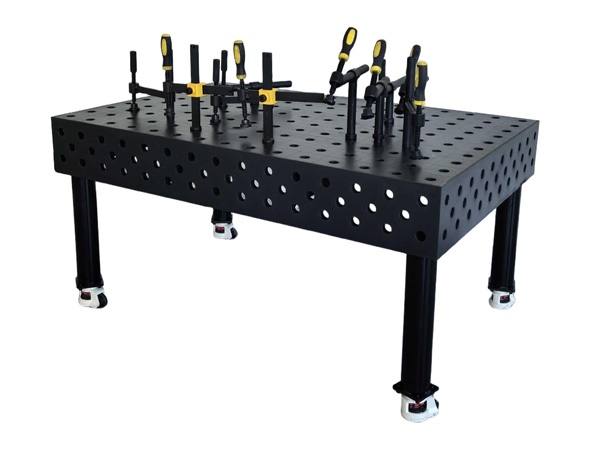
Selecting the best welding table for a fabrication workshop has become increasingly complex. The market now offers a wide range of options—from basic flat plates to fully modular precision tables with integrated clamping systems, surface treatments, and configurable support structures. For workshop owners and production managers, the decision carries significant implications for productivity, weld quality, and long-term return on investment. This guide examines the key factors that differentiate welding table options in 2026, identifies the features that genuinely matter for fabrication operations, and provides a practical framework for selecting the right table for your specific workshop environment.
Defining Your Workshop's Welding Table Requirements
Before evaluating specific products, it is essential to understand your own production requirements. The best welding table for one workshop may be entirely unsuitable for another. Key questions include:
Workpiece size range: What are the dimensions of your largest and smallest typical workpieces? A table that is too small creates constant workarounds; an oversized table wastes floor space and budget.
Production volume: Is your workshop a job shop handling diverse one-off projects, a batch production facility, or a high-volume manufacturer? Job shops need maximum flexibility; high-volume operations may benefit from dedicated fixturing.
Material types and thicknesses: Sheet metal, structural steel, pipe and tube, and heavy plate each impose different demands on table capacity, surface durability, and clamping requirements.
Welding processes used: MIG, TIG, MMA, and flux-cored welding each generate different spatter characteristics and thermal inputs that affect table surface wear.
Operator ergonomics: Table height, mobility requirements, and workspace layout influence operator fatigue and productivity over long shifts.
Documenting these requirements before shopping allows you to filter options efficiently and avoid being swayed by features that do not address your actual production needs.
Key Features to Evaluate in 2026 Welding Tables
The welding table market in 2026 offers several feature categories that directly impact workshop productivity. Understanding these features helps separate essential capabilities from marketing distractions:
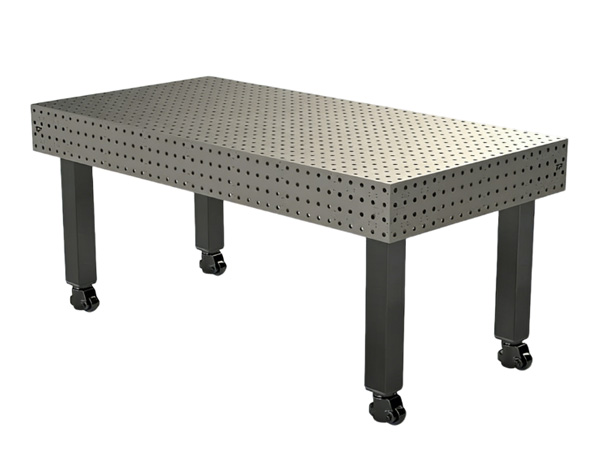
Surface flatness and precision: The fundamental value of a precision welding table lies in its flatness tolerance. Certified tables with flatness of ±0.05 mm/m or better enable accurate assembly without constant measurement. For fabrication workshops producing dimensional work, this is non-negotiable.
Grid pattern and modularity: A 100mm × 100mm grid with threaded holes has become the industry standard. This pattern allows standardized clamping components to be positioned anywhere on the table surface, eliminating the need for custom jigs in most applications.
Load capacity and structural rigidity: Verify the table's rated load capacity matches your heaviest workpieces. A table that deflects under load compromises both weld quality and operator safety.
Surface treatment options: Nitrided surfaces, plasma-hardened surfaces, and specialized coatings extend service life by improving wear resistance and reducing spatter adhesion. For high-production workshops, surface treatment is often worth the incremental cost.
Height adjustability and mobility: Tables with pneumatic or mechanical height adjustment accommodate different operators and tasks. Rolling bases allow table repositioning within the workshop without overhead lifting equipment.
Comparing Table Categories: Which Type Fits Your Workshop
Welding tables available in 2026 generally fall into several categories, each suited to different workshop profiles:
Basic flat plate tables: Simple flat steel surfaces without grid patterns or modular fixturing. Suitable for light fabrication where precision is not critical. Low initial cost but limited flexibility.
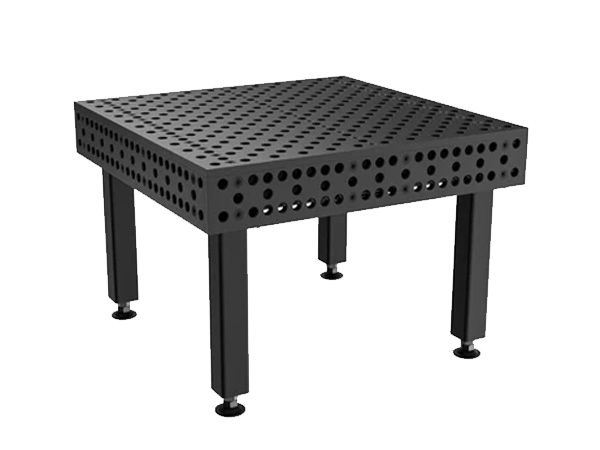
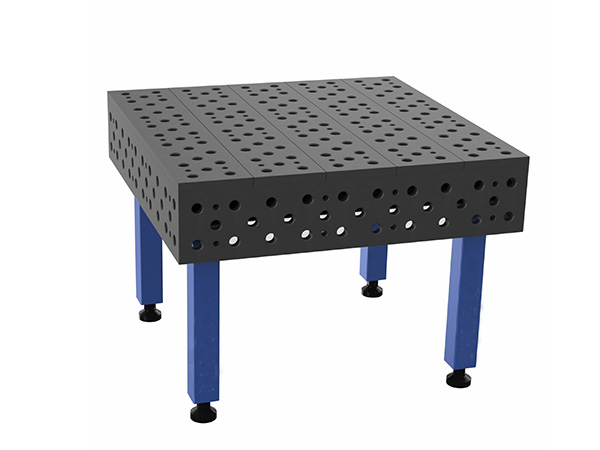
Standard precision welding tables: Machined flat surfaces with 100mm grid patterns. The workhorse choice for general fabrication workshops handling moderate production volumes with diverse part types.
Heavy-duty production tables: Larger tables (1,500 mm × 3,000 mm and up) with reinforced structures and higher load capacities (5,000–10,000 kg). Designed for structural steel fabrication, heavy equipment manufacturing, and large component work.
Specialized tables with surface treatments: Precision tables with nitriding, plasma hardening, or proprietary coatings. Best for high-production workshops where table wear from spatter and clamping is a known issue.
Ergonomic and height-adjustable tables: Tables with integrated height adjustment mechanisms, sit-stand configurations, or tilt capability. Suited to workshops prioritizing operator health and reducing repetitive strain injuries.
Practical Recommendations for Common Workshop Profiles
Based on current market offerings and documented workshop applications, the following recommendations guide the selection of the best welding table for specific scenarios:
Small job shop (1–3 welders, diverse projects): A standard 1,200 mm × 2,400 mm precision table with a comprehensive clamp and stop accessory kit provides maximum flexibility for changing work. Prioritize a reputable manufacturer with proven flatness certification and good accessory availability.
Medium batch production facility: A 1,500 mm × 3,000 mm precision table with nitrided surface treatment reduces maintenance downtime and extends service life. Add modular risers and roller supports for handling longer workpieces.
Structural steel fabricator: Heavy-duty production tables with 5,000+ kg load capacity and floor-anchoring provisions are essential. Multiple tables arranged in a welding cell configuration support efficient workflow for large structural assemblies.
Sheet metal and enclosure manufacturer: A precision table with a smooth, low-spatter surface treatment combined with low-profile clamps minimizes distortion on thin-gauge work. Consider height adjustability to reduce operator fatigue during long runs.
Training and education facility: Smaller precision tables (900 mm × 1,200 mm) with complete accessory kits provide students with hands-on experience in modular fixturing. Prioritize durability and comprehensive manufacturer support.
Building a Complete Welding Table System
The best welding table investment extends beyond the table surface itself. A complete system includes the supporting components that enable productive use:
Clamping and fixturing accessories: Step clamps, flat clamps, toggle clamps, stop bars, angle plates, and V-blocks form the basic kit. A well-equipped accessory set costs 15–25% of the table price but multiplies the table's versatility.
Material handling supports: Roller stands, outriggers, and riser blocks extend the working envelope for oversized workpieces without requiring additional tables.
Ergonomic accessories: Tool organizers, magnetic parts trays, and welding cable management arms keep the work area organized and reduce time spent searching for tools or components.
Maintenance and cleaning tools: Drift pins for grid-hole cleaning, anti-spatter compounds, and precision straightedges for flatness verification should be budgeted as part of the initial purchase.
Evaluating Manufacturers and Suppliers
In 2026, the welding table market includes established precision tooling manufacturers, industrial equipment suppliers, and newer entrants targeting the growing DIY and maker market. For professional fabrication workshops, evaluating the manufacturer is as important as evaluating the product specifications:
Flatness certification: Does the manufacturer provide documented flatness verification for each table? A certificate should show the measurement method, results, and conformance to stated tolerances.
Accessory ecosystem: Is the clamping and fixturing system proprietary or standardized? Can you purchase accessories from multiple sources, or are you locked into one manufacturer's components?
Warranty and support: What warranty terms does the manufacturer offer? Is technical support available if you have questions about setup, maintenance, or accessory compatibility?
Track record: How long has the manufacturer been producing welding tables? Are there documented case studies or testimonials from facilities similar to yours?
Conclusion
The best welding table for a fabrication workshop in 2026 is the one that matches your specific production requirements, provides verified precision and durability, and comes from a manufacturer committed to ongoing support. By evaluating table categories based on surface precision, load capacity, modularity, and surface treatment options, workshop managers can make informed decisions that deliver long-term productivity benefits. The table is not merely a work surface—it is the foundation of the welding cell, and investing in the right platform pays dividends in reduced setup time, improved weld quality, and sustained production efficiency for years to come.
Frequently Asked Questions
A: For workshops with 1–3 welders handling diverse project sizes, a 1,200 mm × 2,400 mm precision table provides sufficient working surface while fitting within typical workshop floor plans. This size accommodates most common fabrication assemblies without excessive overhang.
A: Surface flatness directly affects the dimensional accuracy of welded assemblies. A flatness tolerance of ±0.05 mm/m or better allows parts to be positioned without constant measurement and correction. For any workshop producing dimensional work, certified flatness is essential.
A: For workshops with daily welding production, nitrided surfaces typically justify the 25–40% price premium through extended service life (3–5 times longer) and reduced maintenance. For occasional-use workshops, standard surfaces may be sufficient.
A: Essential accessories include a set of step clamps in multiple sizes, flat clamps, stop bars, and angle plates. Budget 15–25% of the table cost for a comprehensive accessory kit. Add V-blocks, toggle clamps, and risers as specific production needs arise.
A: Request flatness certification documentation, ask for case studies or references from similar fabrication facilities, verify warranty terms, and confirm accessory compatibility and availability. Reputable manufacturers provide this information readily.
References
American Welding Society. (2021). AWS D1.1/D1.1M: Structural Welding Code – Steel. American Welding Society.
Kalpakjian, S., & Schmidt, S. R. (2021). Manufacturing Engineering and Technology (7th ed.). Pearson.
ASM International. (2022). ASM Handbook, Volume 6: Welding, Brazing, and Soldering. ASM International.
ISO 3834-2:2021. (2021). Quality requirements for fusion welding of metallic materials – Part 2: Comprehensive quality requirements. International Organization for Standardization.
American Society of Mechanical Engineers. (2022). ASME BPVC Section IX – Qualification Standard for Welding, Brazing, and Fusing Procedures. ASME.
-
Best Welding Table for Fabrication Workshops: 2026 Buyer's Guide
-
Welding Table Surface Treatments: Nitriding vs Coating
-
Precision Welding Tables: The Ultimate Guide for Jig-Free Welding Operations
-
Welding Fixture Table Safety Standards: A Complete Regulatory Overview
-
Modular Welding Table Layout Strategies for High-Mix Production Facilities
-
Industrial Welding Table Applications in Mass Production Environments
Hebei Yongxin Measuring Tools
Copyright © 2025-2026 http://www.yx-weldingtable.com. All Rights Reserved Hebei Yongxin Measuring ToolsCopyright