






- Navigation -
 Current Location:
NEWS DETAILS
NEWS INFORMATION
Precision Welding Tables: The Ultimate Guide for Jig-Free Welding Operations
AUTHOR:yongxin DATE:2026-08-15 18:59:32 HITS:101
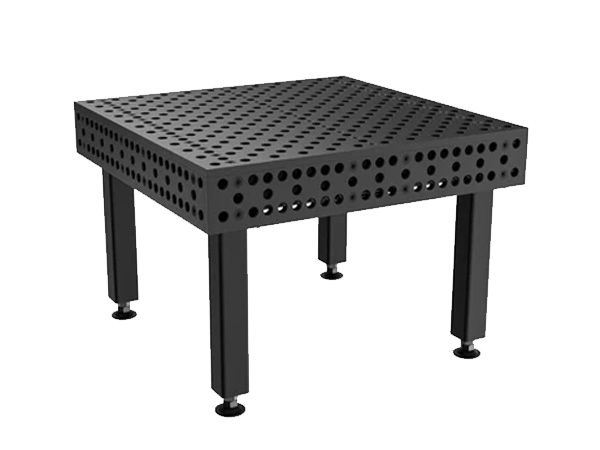
In industrial fabrication, every minute spent setting up a custom jig is a minute taken away from actual welding. As contract manufacturers and in-house production facilities face mounting pressure to reduce lead times and improve throughput, precision welding tables have emerged as a practical alternative to traditional jig-based clamping systems. Rather than building dedicated fixtures for every unique part geometry, fabricators are increasingly turning to modular, grid-pattern precision surfaces that hold workpieces securely without the overhead of specialized tooling. This guide examines how these tables work, what distinguishes a genuinely precise surface from a standard workbench, and what manufacturers should evaluate before making a purchasing decision.
What Are Precision Welding Tables and How Do They Work?
A precision welding table is a flat, engineered work surface designed to accept modular clamping, locating, and support components via a standardized hole pattern. The most widely adopted specification follows a 100mm × 100mm grid with threaded holes, though some manufacturers offer 50mm and 200mm variants depending on the scale of work. The grid itself is precision-machined to tight flatness tolerances—typically ±0.05 mm/m or better—which means the workpiece sits on a surface that does not introduce distortion during fixturing.
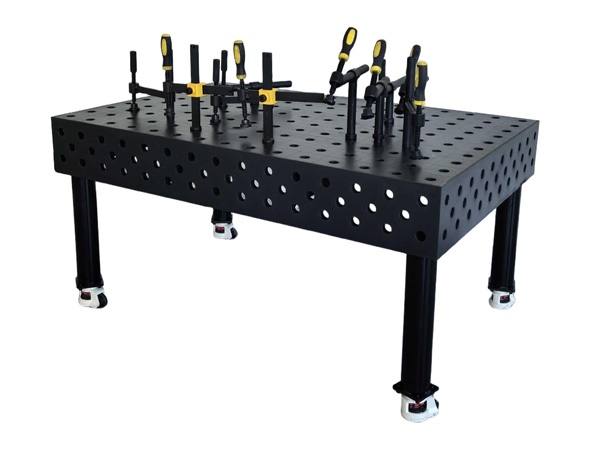
The jig-free advantage comes from combining the flatness of the table surface with purpose-built clamps, stops, and angle plates that lock into the grid. Instead of fabricating a one-off wooden or steel jig for a specific component, the operator assembles a configuration from standardized parts in minutes. When the job changes, the same components are rearranged for the next part. For a jig-free welding operation, this translates to a direct reduction in setup time, which often represents 30–50% of total welding cycle time in job-shop environments.
Key Features That Define a High-Performance Precision Welding Table
Not all precision surfaces are created equal. The following features separate an industrial-grade precision welding table from a simple flat plate:
Flatness tolerance: Certified to ±0.05 mm/m or tighter, measured across the full working surface. This is critical for achieving dimensional accuracy in welded assemblies without post-weld correction.
Grid hole pattern: Uniformly spaced, precisely positioned holes allow consistent placement of clamps and stops regardless of where they are mounted.
Material composition: High-grade steel (typically Q345 or equivalent low-alloy structural steel) heat-treated to resist warping under sustained thermal load from welding operations.
Surface hardness and wear resistance: Brinell hardness of 170–210 HB allows the surface to withstand repeated clamping force without deformation over years of daily use.
Modular compatibility: Interchangeable legs, risers, and rolling bases allow the table to adapt to different workshop layouts and ergonomic requirements.
Precision Welding Tables vs. Traditional Jigs: A Practical Comparison
Fabricators who have relied on traditional jigs often cite the "one jig per part" model as a manageable approach in stable, high-volume production runs. However, when product mix increases or custom orders become more frequent, jig fabrication and storage costs escalate rapidly. A single custom jig can cost anywhere from $500 to $5,000 or more, depending on complexity, and each one occupies storage space while serving only one part number.
A precision welding table consolidates this flexibility into one platform. Operators report that reconfiguring between part families—a structural frame, a sheet-metal enclosure, a tubular assembly—takes 15–30 minutes with a modular table, compared to several hours or even days to build a new jig from scratch. Over a year, this time saving alone can represent hundreds of labor hours for a medium-sized fabrication shop. The table also eliminates the risk of a jig being damaged, misplaced, or made obsolete by a design change.
Applications of Precision Welding Tables in Jig-Free Welding
Jig-free welding operations powered by precision tables cover a broad spectrum of fabrication activities. Some of the most common application areas include:
Structural steel fabrication: I-beams, column bases, and connection plates benefit from the flat reference surface for tack-welding before final passes.
Sheet metal enclosure manufacturing: Alignment pins and edge stops on the grid table ensure that corners meet precisely, reducing gaps that require weld grinding.
tubular assemblies and pipe racks: Angle fixturing components mounted on the grid allow accurate positioning of round or rectangular tubing prior to welding.
Custom one-off fabrication: Job shops handling small-batch or prototype work can configure and reconfigure their setup within the same shift, eliminating the need to pre-build jigs for single parts.
Automated welding integration: Some precision tables are used as base platforms for automated welding cells, where the table's flatness and repeatability support accurate torch positioning.
How to Select the Right Precision Welding Table for Your Facility
Choosing a precision welding table involves evaluating both the table's specifications and the operational context in which it will be used. Here are the primary decision factors:
Table size: Match the working surface to your largest common workpiece. A table too small forces operators to improvise unsupported overhangs; an oversized table wastes floor space and budget.
Load capacity: Verify that the table and its support structure can handle the combined weight of the workpiece, clamping components, and any handling equipment.
Flatness certification: Request a factory calibration certificate. A supplier that cannot provide documented flatness data should be viewed skeptically.
Modular accessory ecosystem: Check that the clamping system, stops, and angle plates are genuinely modular and not proprietary designs that lock you into a single source.
Warranty and support: Industrial-grade tables from reputable manufacturers typically carry a minimum 2-year warranty against manufacturing defects and flatness loss.
Best Practices for Maintaining Precision Welding Tables
Even the finest precision welding table requires regular maintenance to preserve its dimensional accuracy. Spatter, slag, and debris accumulate in the grid holes and on the working surface, gradually degrading flatness and making clamp engagement less reliable. A disciplined maintenance routine includes:
Cleaning the grid holes with a appropriate drift pin or compressed air after each shift
Applying a thin coat of anti-spatter compound or machine oil to the surface before intensive welding sessions
Inspecting the flatness with a precision straightedge and feeler gauge quarterly
Re-surfacing or re-machining the table when cumulative wear exceeds the original flatness specification
Facilities that follow this routine consistently report that their tables maintain calibration for five years or longer under normal production use, representing a strong return on the initial investment.
Conclusion
Precision welding tables represent a practical, cost-effective solution for manufacturers seeking to eliminate or reduce dependence on custom jigs. By providing a certified flat reference surface with a modular grid system, these tables enable rapid setup changes, consistent part quality, and reduced lead times across a wide variety of fabrication tasks. For contract manufacturers handling diverse part mixes and for in-house fabrication departments that need flexibility without sacrificing accuracy, a precision welding table is a strategic capital investment that pays dividends in reduced setup time, improved weld quality, and long-term operational efficiency.
Frequently Asked Questions
A: Most high-quality industrial precision welding tables are certified to a flatness tolerance of ±0.05 mm/m or better. Some ultra-precision tables for aerospace or medical fabrication achieve tolerances of ±0.02 mm/m. Always request the factory calibration certificate to verify the specification.
A: Load capacity varies by model and support structure. Standard floor-standing precision tables typically support 1,000–5,000 kg depending on table size, thickness, and leg configuration. Heavy-duty models can exceed 10,000 kg for large structural fabrication tasks.
A: Yes. Precision welding tables are compatible with all common welding processes including MIG, TIG, MMA (stick welding), and flux-cored arc welding. The key is to apply appropriate anti-spatter protection and follow a regular cleaning schedule to maintain grid hole integrity.
A: Apply a thin layer of anti-spatter compound or high-temperature machine oil to the working surface before welding. Use clamping components to elevate the workpiece slightly off the surface when possible. Clean spatter promptly after each session to prevent accumulation in grid holes.
A: Yes. Tables range from 600 mm × 900 mm up to 1,500 mm × 3,000 mm or larger. Smaller shops can choose a compact model and add modular accessories as needed. Many tables also come with optional caster wheels for easy repositioning within the workshop.
References
ASM International. (2022). Welding Handbook: Fundamentals of Welding (9th ed.). ASM International.
American Welding Society. (2021). AWS D1.1/D1.1M: Structural Welding Code – Steel. American Welding Society.
Kalpakjian, S., & Schmidt, S. R. (2021). Manufacturing Engineering and Technology (7th ed.). Pearson.
ISO 15614-1:2017. (2017). Specification and qualification of welding procedures for metallic materials – Welding procedure test – Part 1: Arc and gas welding of steels and arc welding of nickel and nickel alloys. International Organization for Standardization.
American Society of Mechanical Engineers. (2022). ASME BPVC Section IX – Qualification Standard for Welding, Brazing, and Fusing Procedures. ASME.
-
Precision Welding Tables: The Ultimate Guide for Jig-Free Welding Operations
-
Welding Fixture Table Safety Standards: A Complete Regulatory Overview
-
Modular Welding Table Layout Strategies for High-Mix Production Facilities
-
Industrial Welding Table Applications in Mass Production Environments
-
Best Accessories to Upgrade Your Welding Table Performance
-
Heavy-Duty Welding Table for Shipbuilding Industry Guide
Hebei Yongxin Measuring Tools
Copyright © 2025-2026 http://www.yx-weldingtable.com. All Rights Reserved Hebei Yongxin Measuring ToolsCopyright