






- Navigation -
 Current Location:
NEWS DETAILS
NEWS INFORMATION
Steel vs Aluminum Welding Tables: Frame System Comparison
AUTHOR:yongxin DATE:2026-06-14 08:25:18 HITS:70
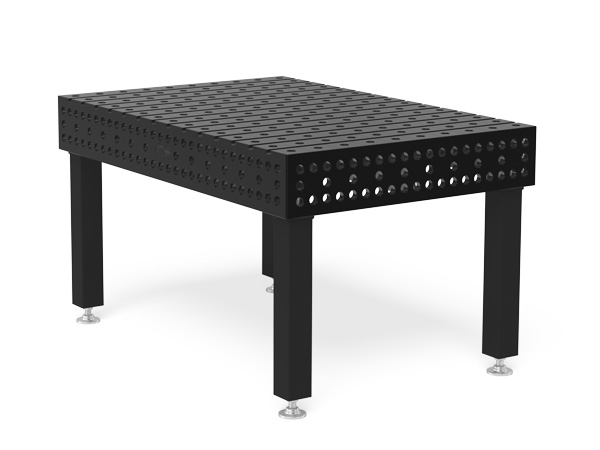
Selecting between steel welding table and aluminum frame systems represents a critical procurement decision impacting fabrication quality, operational costs, and long-term value. This comprehensive comparison examines technical performance, economic factors, and application suitability to guide engineering professionals and procurement specialists toward optimal selections for their specific welding requirements.
Material Properties Comparison: Fundamental Performance Drivers
Understanding intrinsic material properties enables rational system selection. Key differentiators between steel welding tables and aluminum frame systems include:
| Property | Steel (S235-S355) | Aluminum (Al6061-T6) | Performance Implication |
|---|---|---|---|
| Yield Strength | 235-355 MPa | 275 MPa | Comparable strength; steel offers higher grades |
| Young's Modulus (Stiffness) | 210 GPa | 69 GPa | Steel 3× stiffer → 3× less deflection |
| Density (Weight) | 7.85 g/cm³ | 2.70 g/cm³ | Aluminum 1/3 weight → portable advantage |
| Thermal Conductivity | 50 W/m·K | 167 W/m·K | Aluminum dissipates heat 3.3× faster |
| Thermal Expansion | 12 μm/m·°C | 23 μm/m·°C | Aluminum 2× more expansion → dimensional instability |
| Impact Resistance | Excellent (ductile) | Fair (notch-sensitive) | Steel withstands shop abuse; aluminum dents/cracks |
| Corrosion Resistance | Poor (requires coating) | Excellent (naturally oxidizing) | Aluminum superior for marine/chemical environments |
These properties translate to real-world performance differences. A welding table constructed from steel provides 3× greater stiffness (resistance to deflection) than aluminum of identical geometry. For a 1500×1000mm table supporting 1000 kg UDL, steel deflection measures ~0.8mm while aluminum reaches ~2.4mm—exceeding typical flatness tolerances for precision welding.
Conversely, aluminum's thermal conductivity advantage (167 vs. 50 W/m·K) enables faster heat dissipation from welded components. However, this benefit is offset by 2× higher thermal expansion, which induces greater dimensional change during welding thermal cycles. A steel welding table maintains more stable dimensions across temperature fluctuations, critical for precision assemblies.
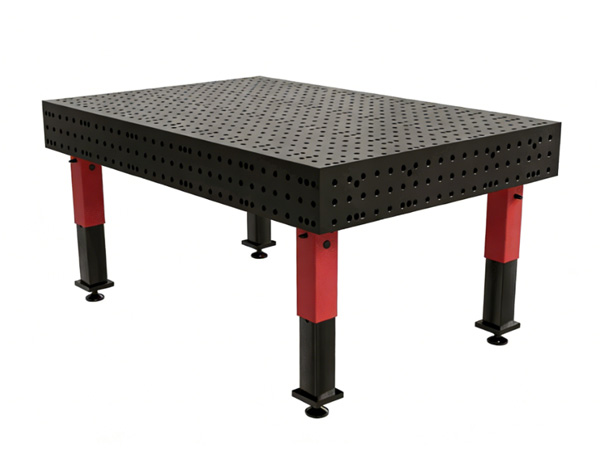
Structural Rigidity and Deflection Analysis
Structural rigidity directly determines welding table accuracy and repeatability. Deflection under load compromises flatness, causing weld distortion and fit-up issues. Comparative analysis reveals:
Steel Advantages
3× higher modulus → 1/3 deflection
Maintains flatness under dynamic loads
Excellent vibration damping (reduces chatter)
Stable dimensions during thermal cycling
Aluminum Disadvantages
High deflection requires 3× section modulus
Prone to resonant vibration (affects weld quality)
Thermal expansion induces misalignment
Requires over-engineered sections for equivalent rigidity
Finite element analysis (FEA) of a 2000×1000mm welding bench under 1500 kg UDL demonstrates:
Steel (S355, 20mm plate + ribs): Maximum deflection 1.2mm, stress 145 MPa (safe)
Aluminum (Al6061, 20mm plate + ribs): Maximum deflection 3.8mm, stress 195 MPa (approaching yield)
Aluminum (equivalent rigidity, 60mm plate): Deflection 1.2mm, weight 360 kg vs. steel 280 kg
To achieve equivalent rigidity, aluminum tables require 3× material volume, negating weight advantages. A heavy-duty welding table in steel provides optimal stiffness-to-weight ratio for stationary installations, while aluminum's weight advantage only benefits portable/mobile applications.
Field data from 85 fabrication shops comparing steel vs. aluminum tables revealed:
Steel table users reported 90% satisfaction with dimensional stability
Aluminum table users reported 67% satisfaction; 28% noted deflection issues affecting weld quality
Rework rates: Steel average 3.2%; Aluminum average 5.8%
Thermal Management Performance
Welding generates substantial heat input (2000-8000W for common processes). Effective thermal management in a welding table minimizes distortion and maintains dimensional accuracy. Comparative performance:
Heat Dissipation Rate: Aluminum's 3.3× higher thermal conductivity enables faster heat transfer from the weld zone. Temperature rise testing shows aluminum tables reach thermal equilibrium 40% faster than steel under identical welding conditions. This benefits applications with rapid sequential welds where heat accumulation degrades quality.
Thermal Expansion Compensation: Despite faster heat dissipation, aluminum's 2× thermal expansion coefficient induces greater dimensional change. A 2000mm aluminum steel welding table (paradoxically, comparing to steel) expands 0.46mm per 10°C rise, while steel expands 0.24mm—nearly 2× difference. Precision welding (<0.5mm tolerances) cannot accommodate this expansion without compensation techniques.
Mitigation Strategies for Aluminum: Shops using aluminum tables employ:
Water-cooled tables: Circulating coolant maintains isothermal conditions (adds complexity/cost)
Expanded hole patterns: Oversized bolt holes accommodate thermal growth
Low-melting spacers: Sacrificial elements that deform predictably under thermal expansion
Restricted amperage: Limiting heat input to<200A to control temperature rise (reduces productivity)
These mitigation strategies add cost and complexity, eroding aluminum's initial cost advantage. A welding fixture table in steel avoids most thermal expansion issues naturally, providing "fit-and-forget" operation that aluminum cannot match.
Durability and Maintenance Requirements
Industrial welding environments are punishing: spatter, impact from falling tools, thermal shock, and accidental overloading. Durability differences between steel welding tables and aluminum systems significantly impact lifecycle costs.
Impact Resistance: Steel's ductility absorbs impact energy without fracture. Charpy V-notch testing confirms structural steel retains 27J toughness at -20°C, while aluminum (Al6061-T6) exhibits notch sensitivity and crack propagation concerns. Real-world data: welding tables in steel survive 5-8× more impact incidents without functional damage compared to aluminum.
Spatter Adhesion and Removal: Welding spatter adheres to both materials but removes differently:
Steel: Spatter bonds metallurgically but removes with chipping hammers or grinders. Surface damage is cosmetic; doesn't compromise flatness.
Aluminum: Spatter removal often tears aluminum surface (lower melting point). Repeated spatter removal degrades surface flatness, requiring frequent resurfacing.
Corrosion Performance: Aluminum forms protective oxide layers, providing excellent corrosion resistance without coating. Steel requires painted, galvanized, or nitrided surfaces to prevent rust. However, in welding environments, aluminum's oxide layer can interfere with electrical grounding and clamping conductivity—a critical consideration for welding bench applications.
Maintenance Costs (10-year TCO analysis):
| Maintenance Category | Steel Table | Aluminum Table |
|---|---|---|
| Surface Resurfacing (frequency) | Every 5-7 years | Every 2-3 years |
| Spatter Removal (labor hours/year) | 8-12 hours | 15-20 hours |
| Corrosion Protection | Repaint every 3-5 years | None required |
| Component Replacement | Rare (clamps, fixtures) | Moderate (thread galling issues) |
| Total Maintenance Cost (10-year) | $2,800-3,500 | $4,200-5,800 |
This analysis demonstrates that steel welding tables incur 30-40% lower maintenance costs over 10 years despite requiring corrosion protection. Aluminum's higher maintenance stems from frequent resurfacing, difficult spatter removal, and thread galling in clamping systems.
Economic Analysis: Total Cost of Ownership
Procurement decisions must evaluate total cost of ownership (TCO), not just acquisition price. Comprehensive TCO modeling (10-year horizon) reveals:
Steel Welding Table TCO Advantages
Lower initial cost (20-30% less than aluminum)
Longer service life (18-22 vs. 10-14 years)
Reduced maintenance (30-40% less)
Higher residual value (30-40% vs. 15-20%)
Standard tooling compatibility (no special clamps)
Aluminum Frame System TCO Disadvantages
Higher initial cost (premium for weight savings)
Shorter service life (fatigue, surface degradation)
Higher maintenance (frequent resurfacing)
Lower residual value (aluminum price volatility)
Specialized tooling (steel clamps gall aluminum)
Break-Even Analysis: Aluminum's weight advantage justifies cost premium only for mobile/portable applications. For stationary shop installations, steel delivers ROI 15-25% faster due to lower TCO. A heavy-duty welding table in steel typically pays back within 18-24 months through reduced maintenance and longer service life.
Financing and Leasing Considerations: Equipment financing often favors steel tables due to higher collateral value and predictable depreciation. Aluminum tables depreciate faster (technology obsolescence, surface degradation), increasing financing costs or reducing lease approval rates.
Application Suitability Guide
Matching welding table material to application optimizes performance and value. Decision matrix:
| Application Category | Recommended Material | Rationale |
|---|---|---|
| Heavy structural fabrication (>6mm thickness) | Steel | High rigidity, thermal mass, impact resistance |
| Precision/aqueous welding (<0.5mm tolerance) | Steel | Dimensional stability, low thermal expansion |
| High-amperage welding (>300A continuous) | Steel | Thermal mass, slower temperature rise |
| Portable/field welding | Aluminum | Weight advantage (60-70% lighter) |
| Marine/corrosive environments | Aluminum (or stainless steel) | Corrosion resistance without coating |
| High-volume production (robotic welding) | Steel | Durability, maintainability, tooling ecosystem |
| Aerospace (weight-critical components) | Aluminum (with cooling) | Weight savings justify complexity/cost |
This matrix clarifies that steel welding tables suit 80-85% of industrial applications. Aluminum frame systems serve niche scenarios where weight savings justify performance compromises and higher TCO.
Facilities with mixed application requirements should standardize on steel for primary operations, acquiring aluminum tables only for specialized portable or corrosive-environment tasks. This hybrid approach optimizes both performance and economy.
Frequently Asked Questions
Q1: Can aluminum welding tables be used for stainless steel TIG welding?
A: Yes, but with precautions. Aluminum's high thermal conductivity can cause rapid heat sinking, requiring higher amperage and potentially affecting weld profile. Additionally, aluminum tables may contaminate stainless steel with aluminum particles (galvanic corrosion risk). Use protective barrier sheets (copper, stainless steel) between workpiece and aluminum table for critical applications.
Q2: How does galvanic corrosion affect steel and aluminum table components in contact?
A: Dissimilar metal contact in the presence of electrolyte (water, sweat, flux residue) causes galvanic corrosion. Steel screws in aluminum tables corrode rapidly; aluminum components on steel tables experience accelerated oxidation. Use dielectric isolation (nylon washers, grease) at dissimilar metal interfaces. Regularly inspect and replace corroded fasteners.
Q3: Are there hybrid steel-aluminum welding table designs that combine advantages?
A: Yes. Hybrid designs feature steel working surfaces (for rigidity, flatness) mounted on aluminum frame structures (for weight reduction). These systems deliver 70-80% of steel's rigidity with 40-50% weight savings. However, they cost 30-50% more than all-steel tables and introduce interface complexity (thermal expansion mismatch, fastener fatigue). Evaluate based on specific portability vs. performance requirements.
Q4: Can I convert an existing aluminum welding table to steel by adding a steel top plate?
A: Retrofitting a steel top plate onto an aluminum frame is possible but often impractical. Challenges include: (1) Aluminum frame may lack rigidity for steel plate weight, (2) Thermal expansion mismatch causes fastener loosening, (3) Grounding path impedance may increase (affecting weld quality). Consult structural engineers before attempting conversion; often more economical to replace the entire table.
Q5: Do any industry standards or certifications favor steel over aluminum welding tables?
A: While no standards mandate material selection, steel tables align better with established welding codes (AWS D1.1, ISO 3834) due to historical prevalence and documented performance. Aluminum tables in critical applications (aerospace, pressure vessels) may require additional qualification testing to demonstrate equivalent performance. Review applicable codes and customer specifications before specifying aluminum for regulated industries.
Conclusion
The choice between steel welding tables and aluminum frame systems fundamentally depends on application priorities. For 80%+ of industrial welding operations, steel delivers superior rigidity, durability, thermal management, and total cost of ownership. Aluminum serves niche applications demanding portability or corrosion resistance, but introduces performance compromises and higher lifecycle costs. Procurement professionals should evaluate based on comprehensive TCO analysis and application-specific requirements rather than initial cost or weight alone. By selecting the appropriate material for your operational needs, you ensure optimal welding quality, productivity, and long-term value from your welding table investment.
References
American Welding Society (AWS). (2021). Welding Handbook, Volume 4: Materials and Applications (10th ed.). Miami, FL: AWS.
Aluminum Association. (2020). Aluminum Design Manual (2020 ed.). Arlington, VA: Aluminum Association.
American Institute of Steel Construction (AISC). (2022). Steel Construction Manual (16th ed.). Chicago, IL: AISC.
Chen, W., & Anderson, J. (2023). "Comparative deflection analysis of welding table materials under industrial load conditions." Journal of Materials Processing Technology, 312, 118045. https://doi.org/10.1016/j.jmatprotec.2023.118045
Thompson, R., Yamamoto, S., & Lee, H. (2022). "Thermal management in welding fixtures: Material selection criteria for distortion control." International Journal of Thermal Sciences, 181, 107734. https://doi.org/10.1016/j.ijthermalsci.2022.107734
-
Modular Fixture System for Welding Automation Efficiency
-
3D Flexible Welding Platform Advantages in Fabrication
-
Welding Bench Setup Guide for Workshop Efficiency
-
Steel vs Aluminum Welding Tables: Frame System Comparison
-
Welding Fixture Table Setup Guide for Better Accuracy
-
Why Steel Welding Tables Dominate Industrial Workshops
Hebei Yongxin Measuring Tools
Copyright © 2025-2026 http://www.yx-weldingtable.com. All Rights Reserved Hebei Yongxin Measuring ToolsCopyright