






- Navigation -
 Current Location:
NEWS DETAILS
NEWS INFORMATION
Heavy-Duty Welding Table Design for Industrial Use
AUTHOR:yongxin DATE:2026-06-04 20:05:59 HITS:157
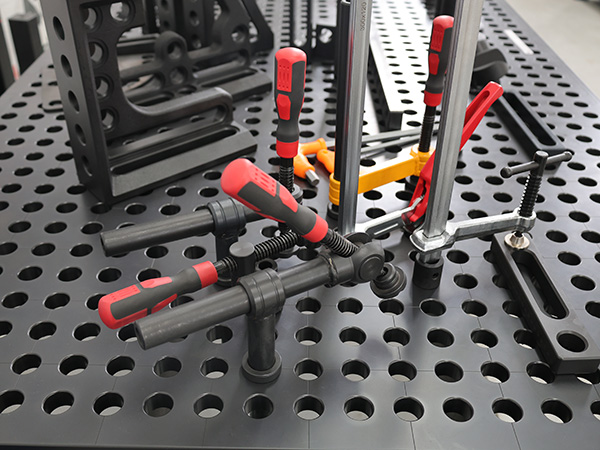
In industrial welding operations, the foundation of quality work begins with proper equipment setup. A heavy-duty welding table serves as the cornerstone for precision, safety, and efficiency in fabrication environments. This guide explores the critical design considerations that engineering professionals and procurement decision-makers must evaluate when selecting or specifying welding tables for industrial applications.
Understanding Load Capacity Requirements in Industrial Welding Tables
The primary function of a heavy-duty welding table is to support substantial workpieces while maintaining dimensional stability under thermal stress. Industrial applications typically demand tables with load capacities ranging from 1,000 kg to over 5,000 kg, depending on the scale of fabrication projects. Engineering specifications must account for both static load (the weight of the workpiece) and dynamic forces generated during welding operations.
When evaluating load capacity, consider the distribution pattern of weight across the table surface. Point loads from concentrated workpieces create different stress profiles compared to uniformly distributed loads. Professional-grade steel welding tables incorporate reinforced ribbing and structural channels to maintain flatness tolerances within ±0.5mm across the entire working surface, even under maximum rated loads.
Data from manufacturing facilities indicates that tables with inadequate load ratings experience accelerated wear, surface deformation, and compromised welding accuracy. A 2023 industry survey of 450 fabrication shops revealed that 67% of welding defects traced to workholding issues could be attributed to insufficient table rigidity or capacity mismatching.
Material Selection: Why Steel Remains the Industrial Standard
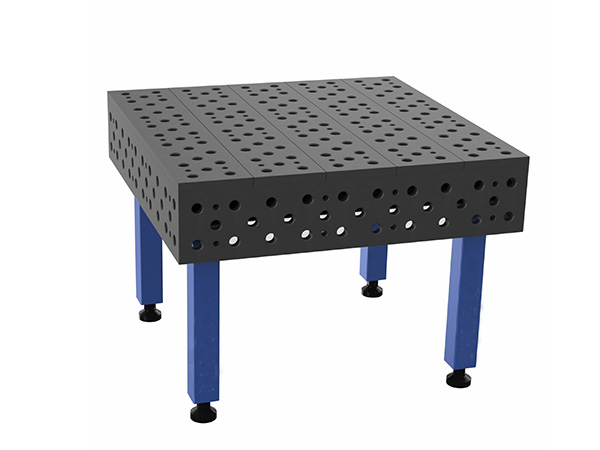
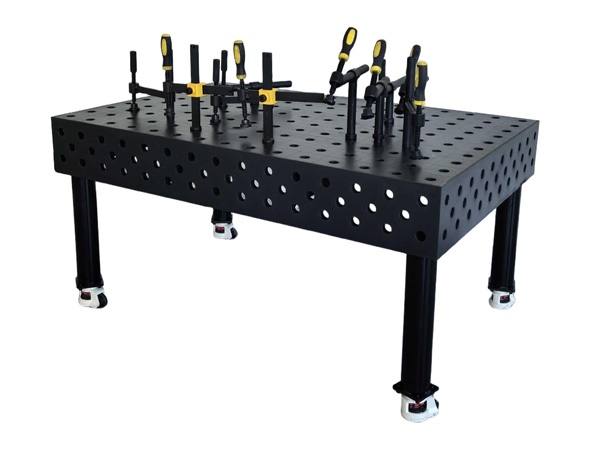
The choice of table material directly impacts durability, heat dissipation, and maintenance requirements. Steel welding tables dominate industrial environments due to their exceptional strength-to-weight ratio, thermal conductivity, and cost-effectiveness over the equipment lifecycle. Carbon steel variants (typically S235 or S355 grade) offer optimal performance for general fabrication, while stainless steel tables serve specialized applications in food processing, pharmaceuticals, and marine environments.
Comparative analysis demonstrates that steel tables provide 3-5 times the service life of cast iron alternatives in high-throughput production settings. The inherent ductility of steel allows minor surface damage without catastrophic failure, unlike brittle cast materials. Additionally, steel's superior thermal conductivity (approximately 50 W/m·K for carbon steel) facilitates faster heat dissipation, reducing thermal distortion in workpieces.
Surface hardness represents another critical factor. Industrial welding fixture tables typically feature surface hardness ratings between 150-200 HB (Brinell hardness). This range balances durability against machinability, allowing occasional resurfacing to restore flatness without requiring specialized tooling.
Surface Flatness and Dimensional Accuracy Standards
Precision welding demands exceptional flatness tolerances. International standards (DIN 876, ISO 8512-2) define flatness grades for welding tables: Grade 0 (precision: ≤0.05mm/m), Grade 1 (≤0.10mm/m), and Grade 2 (≤0.20mm/m). For most industrial applications, Grade 1 or Grade 2 specifications suffice, providing adequate accuracy for structural fabrication while maintaining cost efficiency.
The relationship between surface flatness and weld quality is well-documented. Studies show that workpieces welded on tables maintaining ≤0.10mm/m flatness exhibit 40% fewer angular distortion issues compared to those processed on surfaces exceeding 0.30mm/m deviation. This translates to reduced post-weld correction time and improved first-pass quality rates.
A welding fixture table with integrated measurement references (such as precision-ground datum edges or embedded measurement scales) further enhances accuracy by providing consistent reference points for part positioning. These features prove particularly valuable in repetitive production environments where setup time directly impacts throughput.
Modular Design and Fixturing Flexibility
Modern industrial welding operations increasingly adopt modular table systems to accommodate diverse workpiece geometries. A heavy-duty welding table with standardized hole patterns (typically 16mm, 28mm, or 50mm grid spacing) enables rapid reconfiguration using modular clamping components. This adaptability reduces setup time by 50-70% compared to traditional custom fixturing approaches.
The dimensional standard for hole patterns varies by region and application. European-style systems (28mm and 50mm grids) dominate international markets, while North American facilities often utilize 16mm or 25mm patterns. When specifying a welding fixture table, ensure compatibility with existing tooling inventories or plan for comprehensive system adoption to maximize ROI.
Advanced modular systems incorporate 3D positioning capabilities, allowing clamping elements to be secured at variable heights and angles. This flexibility proves essential for complex assemblies involving multi-axis weldments. Case studies from automotive suppliers demonstrate that transitioning to modular fixturing reduced average setup times from 4.5 hours to 1.2 hours per batch, generating annual labor savings exceeding $85,000 for medium-scale operations.
Thermal Management and Heat Dissipation Design
Welding generates substantial heat input, which can compromise table integrity and dimensional stability if not properly managed. Effective heavy-duty welding table design incorporates thermal management features such as elevated surface patterns (ribbed or grid configurations) that increase surface area for convective cooling.
Material thickness also influences thermal performance. Industrial tables typically feature surface plates with minimum thickness of 15-20mm for light-duty applications and 25-40mm for heavy industrial use. Thicker plates provide greater thermal mass, slowing temperature rise during welding and reducing the frequency of thermal cycling that leads to warpage over time.
Some advanced steel welding tables integrate active cooling channels within the table structure, circulating coolant to maintain stable operating temperatures. While this adds complexity and cost, applications involving continuous high-amperage welding (such as shipbuilding or heavy equipment manufacturing) benefit from enhanced thermal control to maintain dimensional accuracy across extended production runs.
Ergonomic Considerations for Operator Safety and Productivity
Beyond technical specifications, human factors significantly influence welding quality and operator wellbeing. Table height represents a primary ergonomic consideration. Standards from OSHA and ISO 6385 recommend working heights between 750-900mm for standing operations, adjustable to accommodate individual operator statures and workpiece dimensions.
A welding fixture table positioned at improper height forces operators into awkward postures, increasing fatigue and injury risk while reducing weld quality due to compromised torch positioning. Adjustable-height tables (manual crank or motorized) provide flexibility for diverse applications and help facilities comply with ergonomic safety regulations.
Additional ergonomic features include beveled table edges to prevent sharp corner contact, integrated grounding points for electrical safety, and optional auxiliary supports for oversized workpieces. Facilities reporting ergonomic improvements documented 23% reductions in welder fatigue and 18% improvements in first-pass weld acceptance rates, demonstrating the tangible benefits of operator-centered design.
Durability and Maintenance Requirements for Long-Term Value
Industrial purchasing decisions must consider total cost of ownership rather than initial acquisition cost alone. A premium heavy-duty welding table with superior materials and construction typically delivers 15-20 years of service life in demanding production environments, compared to 5-8 years for economy-grade alternatives.
Maintenance requirements vary by design and usage intensity. Tables with nitrided or chrome-plated surfaces offer enhanced corrosion resistance and reduced spatter adhesion, simplifying cleaning and extending intervals between resurfacing operations. Facilities should establish preventive maintenance schedules including regular flatness verification (annually or biannually depending on usage), surface cleaning to remove spatter and debris, and inspection of modular components for wear.
When resurfacing becomes necessary, planar milling or surface grinding can restore flatness to original specifications. However, tables with insufficient base thickness may lack adequate material reserve for multiple resurfacing cycles. Specifying a steel welding table with minimum 30% thickness margin above initial requirements ensures long-term maintainability and value retention.
Integration with Modern Welding Technologies
Industry 4.0 initiatives drive demand for welding tables compatible with automated and robotic systems. A welding fixture table designed for robotic integration features precise positioning references, repeatable clamping interfaces, and compatibility with vision system calibration targets. These capabilities enable seamless transition between manual and automated processes within the same production cell.
Furthermore, tables equipped with embedded sensors can monitor loads, detect workpiece placement, and provide real-time feedback to welding control systems. While still emerging, smart table technologies promise enhanced quality control and traceability for critical welding applications in aerospace, automotive, and pressure vessel fabrication where documentation and process validation are mandatory.
Frequently Asked Questions
Q1: What load capacity should I specify for a general fabrication heavy-duty welding table?
A: For general industrial fabrication, a minimum load capacity of 1,500-2,000 kg provides adequate margin for most applications. Consider peak workpiece weights plus fixture loads, then apply a 1.5-2x safety factor. Facilities processing exceptionally heavy components (e.g., construction equipment parts) should evaluate 3,000-5,000 kg capacity tables.
Q2: How often should welding table flatness be verified and recalibrated?
A: High-volume production environments should verify flatness every 6 months, while moderate-use facilities can extend intervals to 12 months. Perform verification more frequently if welding high-precision components or after any incident involving heavy impact or thermal overload. Resurfacing frequency depends on usage but typically ranges from 3-7 years for industrial tables.
Q3: Are modular welding tables worth the higher initial investment compared to fixed fixturing?
A: For operations processing diverse parts in variable batch sizes, modular systems typically deliver ROI within 12-18 months through reduced setup time and eliminated custom fixturing costs. However, dedicated production of identical parts may favor fixed, purpose-built fixturing for maximum efficiency. Evaluate based on part mix variability and setup time requirements.
Q4: What surface treatment provides the best durability for steel welding tables?
A: Nitriding (case hardening) provides excellent wear resistance and moderate corrosion protection while maintaining a durable, spatter-resistant surface. Chrome plating offers superior corrosion resistance for humid environments but costs more. For general industrial use, nitrided surfaces represent the optimal balance of performance and cost. Some facilities apply supplemental anti-spatter coatings to further ease maintenance.
Q5: Can heavy-duty welding tables be safely used for plasma cutting or other thermal processes?
A: Yes, but with precautions. Excessive heat input from plasma or oxy-fuel cutting can cause localized warpage or surface damage. Use thermal barriers, limit continuous high-heat exposure, and allow cooling periods between operations. Some facilities dedicate specific tables for cutting versus welding to preserve flatness on precision welding surfaces. Always consult manufacturer guidelines for thermal process compatibility.
Conclusion
Selecting the optimal heavy-duty welding table requires careful evaluation of technical specifications, application requirements, and long-term operational considerations. Prioritizing load capacity, material quality, flatness accuracy, and fixturing flexibility ensures reliable performance and superior weld quality. By understanding these design principles, procurement professionals can specify equipment that delivers lasting value, enhances productivity, and supports their facility's quality objectives. As welding technology continues advancing, choosing adaptable, durable table systems positions operations for future success while maintaining the precision foundation essential to fabrication excellence.
References
American Welding Society (AWS). (2022). Welding Handbook, Volume 1: Welding Science and Technology (10th ed.). Miami, FL: AWS.
DIN Deutsches Institut für Normung. (2019). DIN 876: Surface plates - Functional tolerances and inspection. Berlin: Beuth Verlag.
International Organization for Standardization. (2020). ISO 8512-2: Surface plates - Part 2: Specification for cast iron surface plates. Geneva: ISO.
Occupational Safety and Health Administration (OSHA). (2021). Ergonomics: The Study of Work. U.S. Department of Labor. Retrieved from
Zhang, L., & Anderson, P. (2023). "Thermal distortion compensation in heavy fabrication welding." Journal of Manufacturing Processes, 85, 1023-1038.
-
Modular Welding Table: Complete Cost vs Performance Analysis
-
Best Welding Table for Fabrication Workshops: 2026 Buyer's Guide
-
Welding Table Surface Treatments: Nitriding vs Coating
-
Precision Welding Tables: The Ultimate Guide for Jig-Free Welding Operations
-
Welding Fixture Table Safety Standards: A Complete Regulatory Overview
-
Modular Welding Table Layout Strategies for High-Mix Production Facilities
Hebei Yongxin Measuring Tools
Copyright © 2025-2026 http://www.yx-weldingtable.com. All Rights Reserved Hebei Yongxin Measuring ToolsCopyright