






- Navigation -
 Current Location:
NEWS DETAILS
NEWS INFORMATION
How to Choose the Right Welding Table for Your Workshop?
AUTHOR:yongxin DATE:2026-02-22 16:13:47 HITS:146
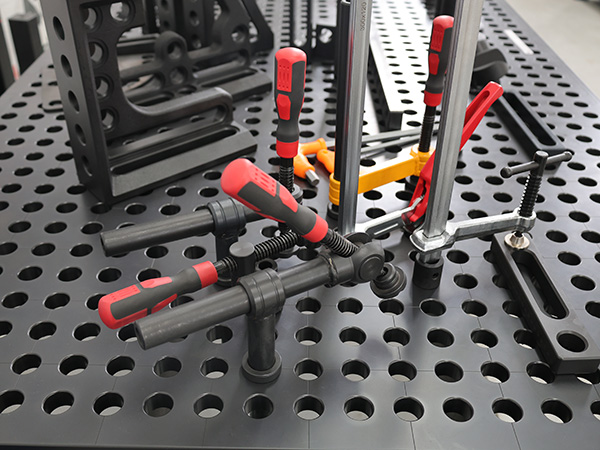
Choosing the right welding table boils down to matching your workpiece size/weight,welding processes,precision needs,and shop workflow to the table’s core specs.Below is a step-by-step guide to avoid overbuying or underperforming.
1.Define Your Workpiece&Load Requirements(Critical)
Start with your largest common workpiece dimensions and maximum combined weight(workpiece+fixtures+tools).
Size rule:The table should comfortably fit the workpiece with 30–50 cm of clearance on all sides for clamping and maneuvering.Small shops:1m×1m to 1.5m×1m;large assemblies:2m×1m or larger,or modular extensions.
Thickness&capacity:Match top thickness to load to prevent warping:
Light(≤200 kg):12 mm top
Medium(200 kg–2 tons):16 mm top
Heavy(>2 tons):25 mm+top with reinforced frame
Weight capacity:Always select a table rated 20–30%above your expected max load for safety and longevity.
2.Choose the Right Table Top Type for Precision&Fixturing
The top design dictates how you secure work and maintain accuracy.
Plain top:Budget-friendly for simple jobs;use clamps,magnets,or custom jigs.Best for low-mix,low-precision work.
T-slot top:Integrated T-slots for quick bolt-on fixtures.Ideal for repetitive batches and medium precision.
3D modular(hole-grid)top:The most versatile option.Features a 50 mm or 100 mm hole pitch on 5 precision-machined surfaces(top+four sides)for multi-axis fixturing.Choose 50 mm pitch for small,precise parts;100 mm pitch for large assemblies(cost-effective).
Flatness grade:For fabrication,aim for grade 2 or 3;for precision welding/inspection,grade 0 or 1 is required.
3.Prioritize Material,Hardness&Durability
Core material:S355J2+N steel is industry standard for heavy-duty use,offering high toughness and resistance to warping.Avoid low-carbon steel for frequent heavy welding.
Surface treatment:Look for plasma nitriding(hardens surface to resist wear and weld spatter)and anti-rust coating(critical for humid shops).
Frame:Reinforced steel frames ensure stability under load;check for full welds and robust cross-bracing.
4.Decide on Mobility&Ergonomics
Leg configuration:
Leveling pads:Best for fixed workstations;ensures maximum stability and flatness(required for precision work).
Locking casters:For mobile shops or large floors;use only with heavy-duty brakes to prevent movement during welding.
Height adjustability:Fixed height(75–85 cm)suits most welders;adjustable height tables reduce fatigue during long shifts and accommodate different tasks(e.g.,flat vs.vertical welding).
5.Match to Your Welding Process
MIG/MAG:High spatter resistance is key;a hardened,smooth top with easy cleanup is ideal.Modular fixturing speeds up repeat jobs.
TIG:Precision is paramount;a flat,stable table with fine-adjustment fixturing(e.g.,3D modular)ensures accurate alignment.
Stick(SMAW):Durability and heat resistance are critical;a thick steel top with a reinforced frame handles heavy heat input and rough use.
6.Factor in Accessories&Modularity
Must-have accessories:Retaining clamps,angle stops,V-blocks,and fixture plates(for 3D tables).
Nice-to-haves:Tool storage,integrated vise mounts,and grounding points(ensures safe,reliable electrical connection).
Modularity:If your projects vary in size/shape,a modular 3D table lets you reconfigure fixturing quickly,reducing setup time and improving productivity.
7.Balance Budget&Long-Term Value
Entry-level(hobbyist):Plain 12 mm steel top,fixed legs,basic capacity.Best for occasional light work.
Mid-range(professional):16 mm T-slot or 3D top,leveling pads,moderate capacity.Suitable for small to medium shops.
High-end(industrial):25 mm+nitrided 3D top,reinforced frame,high capacity,and full accessory kit.Invest if you do heavy,high-precision work daily.
Warranty:Look for 1–5 years on structural integrity;a longer warranty indicates quality materials and construction.
Final Quick-Select Checklist
Measure your largest workpiece and calculate max load.
Choose top type(plain/T-slot/3D)based on fixturing needs.
Select top thickness(12/16/25 mm)matching load.
Opt for leveling pads(precision)or casters(mobility).
Ensure surface treatment(nitriding/anti-rust)for your environment.
Verify flatness grade for your precision requirements.
Budget for essential accessories(clamps,stops).
By following these steps,you’ll select a welding table that boosts efficiency,ensures safety,and grows with your workshop’s needs.
GB/T 7714:Yahya M,Zhou B,Breslin J G,et al.Semantic modeling.development and evaluation for the resistance spot weldingindustry[J].IEEE Access,2023,11:37360-37377.
MLA:Yahya,Muhammad,et al."Semantic modeling,developmentand evaluation for the resistance spot welding industry."IEEEAccess 11(2023):37360-37377.
APA:Yahya,M.,Zhou,B.,Breslin,J.G.,Ali,M.I.,&Kharlamov,E.(2023).Semantic modeling,development and evaluation forthe resistance spot welding industry.IEEE Access,11,37360-37377.
-
3D Welding Table Made of Nitrided Steel: Advantages for Modern Welding Systems
-
Choosing the Right Precision 3D Welding Table for Your Workshop
-
Benefits of Using a 3D Welding Jig Table in Professional Manufacturing
-
Complete Guide to 3D Modular Steel Welding Tables: Features & Benefits
-
Workshop Cast Iron Welding Table: The Ultimate Guide to Durability & Precision
-
Cast Iron Plate Welding Table: Durability, Precision & Applications for Professional Welding
Hebei Yongxin Measuring Tools
Copyright © 2025-2026 http://www.yx-weldingtable.com. All Rights Reserved Hebei Yongxin Measuring ToolsCopyright