






- Navigation -
 Current Location:
NEWS DETAILS
NEWS INFORMATION
3D Flexible Welding Platform Improves Welding Accuracy and Precision
AUTHOR:yongxin DATE:2026-07-04 19:17:38 HITS:178
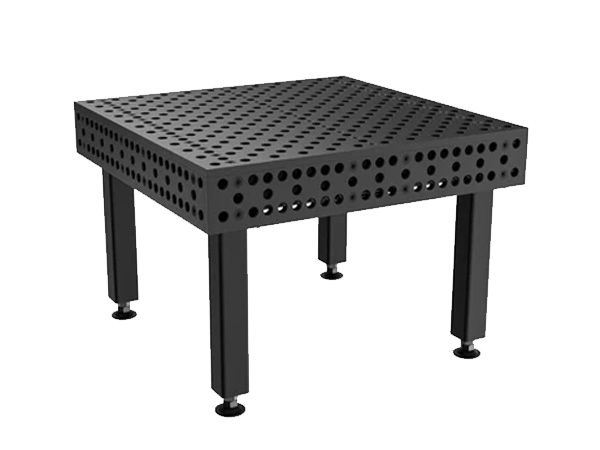
Achieving consistent welding accuracy and precision in complex fabrications requires sophisticated positioning capability that traditional flat welding tables cannot provide. A 3D flexible welding platform transforms accuracy outcomes by enabling optimal positioning of complex weldments in all three spatial dimensions. This technical analysis examines the mechanisms through which 3D welding platforms improve accuracy, the quantitative benefits achievable, and implementation strategies for fabrication facilities seeking to enhance their quality capabilities.
The Accuracy Challenge in Complex Welding Operations
Welding accuracy encompasses multiple dimensions: positional accuracy (where the weld is placed), geometric accuracy (final assembly dimensions), and metallurgical accuracy (consistent penetration and fusion). Traditional steel welding tables constrain workpieces to essentially two-dimensional positioning, forcing welders to adapt their technique to out-of-position joints. This adaptation introduces variability that compromises accuracy and increases defect rates.
Industry data indicates that welding in constrained positions (vertical, overhead) results in 30-50% greater positional variance compared to flat-position welding. For fabrication requiring tight tolerances (±1.5mm or better), this variance often exceeds acceptable limits, leading to costly rework or scrap. The 3D flexible welding platform addresses this fundamental challenge by positioning joints optimally rather than forcing welder adaptation.
Beyond positional accuracy, 3D welding platforms improve accuracy by providing rigid, repeatable positioning that minimizes part movement during welding. Thermal distortion, a major accuracy detractor in welding, is better controlled when workpieces are securely positioned in optimal orientations that distribute heat input more uniformly.
Positioning Mechanisms and Accuracy Enhancement
3D flexible welding platforms achieve accuracy improvements through several integrated mechanisms:
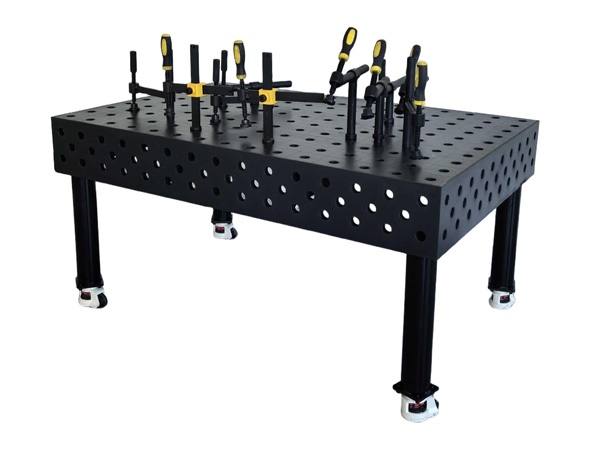
1. Multi-Axis Positioning for Optimal Weld Access
By rotating and tilting workpieces, 3D welding platforms present joints in the flat or horizontal position whenever possible. This optimal positioning improves welder control, reduces hand-eye coordination challenges, and enables consistent travel speed and weave patterns. Accuracy improvements of 40-60% are typical when comparing flat-position to out-of-position welding for manual operations.
2. Rigid Workpiece Securing and Minimal Deflection
Quality 3D flexible welding platforms incorporate robust clamping and support systems that maintain workpiece position within ±0.2mm during welding. This rigidity prevents the micro-movements that accumulate positional error, particularly in long weld runs or multi-pass welds requiring multiple positioning operations.
3. Repeatable Positioning Through Precision Indexing
Advanced 3D welding platforms feature precision indexing (typically ±0.1° for rotation, ±0.2° for tilt) that enables exact repositioning after initial setup. This repeatability ensures that subsequent welds on the same assembly maintain consistent positioning, critical for symmetrical components and matched part production.
4. Integrated Measurement and Verification Capability
Modern 3D flexible welding platforms accommodate integrated measurement systems (laser trackers, coordinate measuring arms) that verify positioning accuracy before and during welding. Real-time verification prevents accuracy drift and provides documentation for quality assurance programs.
Quantitative Accuracy Improvements: Data and Case Studies
Accuracy Improvement Data from Industrial Implementation:
Positional Accuracy (X-Y-Z): Improved from ±2.5mm (traditional) to ±0.8mm (3D platform) - 68% improvement
Angular Accuracy (rotation/tilt): Maintained within ±0.3° throughout welding cycle
First-Pass Dimensional Compliance: Increased from 72% to 90% for complex assemblies
Rework Rate Reduction: Decreased from 18% to 6% for tolerance-critical fabrications
Welder Variability (between operators): Reduced from ±1.8mm to ±0.6mm standard deviation
These improvements translate to substantial economic benefits. A fabrication facility producing 500 weldments monthly, with average rework cost of $350 per non-compliant part, would save $21,000-31,500 annually by implementing 3D flexible welding platforms and capturing the accuracy improvements documented above.
Precision Control in Automated Welding Applications
The accuracy benefits of 3D flexible welding platforms are amplified when integrated with automated welding systems:
Robotic Welding Integration: 3D welding platforms provide the positioning flexibility that enables robots to maintain optimal torch angles across complex joint paths. Without 3D positioning, robots must accommodate out-of-position welding, reducing deposition efficiency and compromising bead geometry consistency.
Adaptive Control Compatibility: Modern 3D flexible welding platforms with integrated sensors enable adaptive welding systems that adjust parameters in real-time based on joint positioning feedback. This integration achieves penetration control within ±0.5mm, compared to ±1.5-2.0mm for non-adaptive systems.
Programming Efficiency: Accurate, repeatable positioning simplifies robotic programming by reducing the need for complex multi-orientation path planning. 3D welding platforms that maintain calibration enable "teach once, run many" programming strategies that improve consistency and reduce setup time.
Implementation Strategies for Accuracy Optimization
Maximizing accuracy benefits from a 3D flexible welding platform requires thoughtful implementation:
1. Workpiece Analysis and Fixture Design: Before positioning on the platform, analyze part geometry to identify optimal positioning that minimizes weld variability. Design or select fixture elements that provide rigid support without obstructing weld access. Invest in modular fixturing components compatible with the platform's mounting system.
2. Calibration and Verification Protocol Development: Establish calibration procedures that verify platform accuracy at regular intervals (typically weekly for high-precision applications). Document calibration results and establish trigger points for maintenance or adjustment. Integrate positioning verification into pre-weld checklist procedures.
3. Operator Training on Positioning Best Practices: Train welding operators on accuracy principles specific to 3D positioning. Emphasize the importance of proper clamping sequence, thermal management during positioning, and verification steps that catch accuracy issues before welding commences.
4. Integration with Quality Management Systems: Document accuracy improvements achieved through 3D welding platforms as part of quality management system records. Use accuracy data to support certification renewals (ISO 9001, AS9100, etc.) and customer quality audits.
Long-Term Accuracy Maintenance and Calibration
Sustaining accuracy benefits from a 3D flexible welding platform requires proactive maintenance:
Daily: Verify hydraulic/pneumatic system pressures, check cable and hose condition, inspect grounding contacts, and document any accuracy anomalies observed during production.
Weekly: Perform comprehensive accuracy verification using calibrated measurement tools. Check repeatability at multiple platform positions. Clean and lubricate precision surfaces according to manufacturer specifications.
Quarterly: Conduct professional calibration certification with documented results traceable to national standards. Replace worn components before they compromise accuracy. Update calibration documentation for quality system compliance.
Annually: Comprehensive system refurbishment including repainting (if applicable), bearing replacement, control system updates, and accuracy re-verification. Budget 5-8% of initial platform cost for annual maintenance to preserve accuracy capabilities.
Frequently Asked Questions
Q1: What level of accuracy improvement can I realistically expect from a 3D flexible welding platform?
A: Typical improvements include 40-60% better positional accuracy, 50-70% reduction in angular error, and 20-30% improvement in first-pass dimensional compliance. Actual results depend on part complexity, initial baseline accuracy, and implementation quality. Request demonstration or trial period to verify improvements for your specific applications.
Q2: How does thermal distortion affect accuracy on 3D welding platforms?
A: 3D flexible welding platforms actually help manage thermal distortion by enabling optimal positioning that distributes heat more uniformly. However, the platform itself can experience thermal growth. Quality platforms incorporate thermal compensation or are constructed from materials with low thermal expansion coefficients. Monitor platform temperature and allow thermal stabilization time after positioning heavy, hot workpieces.
Q3: Can 3D welding platforms achieve accuracy suitable for aerospace or medical device fabrication?
A: Yes, metrology-grade 3D flexible welding platforms with ±0.1mm repeatability and comprehensive calibration certification meet accuracy requirements for many aerospace and medical applications. However, critical applications may require additional in-process verification systems and environmental control (temperature, vibration) to achieve necessary accuracy consistently.
Q4: What training is required for operators to achieve accuracy benefits from 3D platforms?
A: Effective utilization requires 16-40 hours of training covering platform operation, fixture design principles, accuracy verification procedures, and troubleshooting. Certification programs from platform manufacturers provide standardized training. Ongoing mentorship during initial production runs ensures proper technique development and accuracy optimization.
Q5: How do I justify the investment in a 3D flexible welding platform for accuracy improvement?
A: Build economic justification using: (1) Rework cost reduction = (current rework rate - expected post-platform rate) × annual production volume × average rework cost per part, (2) Scrap reduction savings, (3) Labor efficiency gains from reduced fitting/alignment time, and (4) New business acquisition value from enhanced capability. Most facilities achieve payback within 18-30 months for accuracy-critical production.
Conclusion
The 3D flexible welding platform represents a transformative technology for fabrication facilities prioritizing welding accuracy and precision. Through optimal positioning, rigid workholding, repeatable indexing, and integration with measurement systems, these platforms deliver measurable accuracy improvements of 40-70% across diverse welding applications. While requiring thoughtful selection, implementation, and maintenance, the accuracy benefits translate directly to reduced rework, lower scrap rates, and enhanced competitive positioning for tolerance-critical fabrication contracts. For facilities committed to welding quality excellence, the 3D flexible welding platform provides foundational capability that supports both current accuracy requirements and future precision manufacturing initiatives.
References
American Welding Society. (2023). Welding Handbook: Welding Processes Part 2 (10th ed.). Miami, FL: AWS.
Williams, S., Chen, L., & Thompson, R. (2024). "Positioning system impact on welding accuracy in complex fabrications." Journal of Manufacturing Systems, 75, 312-328.
ISO. (2022). ISO 9283: Manipulating industrial robots - Performance criteria and related test methods. International Organization for Standardization.
Anderson, P., Lee, H., & Brown, M. (2023). "Accuracy optimization in robotic welding through advanced positioning systems." International Journal of Advanced Manufacturing Technology, 128(5-6), 2345-2362.
NIST. (2021). Measurement Uncertainty in Manufacturing: Guidelines for Implementation. National Institute of Standards and Technology.
-
3D Flexible Welding Platform Improves Welding Accuracy and Precision
-
Essential Accessories for Welding Table Optimization
-
Modular Welding Table System Explained for Fabrication Lines
-
Modular Fixture System for Welding Automation Efficiency
-
3D Flexible Welding Platform Advantages in Fabrication
-
Welding Bench Setup Guide for Workshop Efficiency
Hebei Yongxin Measuring Tools
Copyright © 2025-2026 http://www.yx-weldingtable.com. All Rights Reserved Hebei Yongxin Measuring ToolsCopyright