






- Navigation -
 Current Location:
PRODUCTS DETAILS
PRODUCTS DISCRIPT
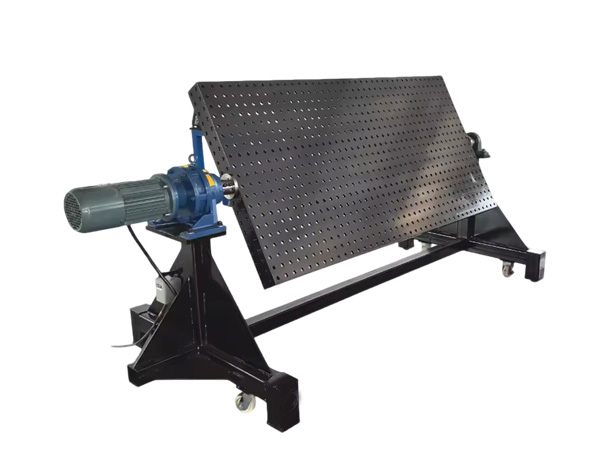
Rotating Welding Table
The rotating welding table, also known as a welding turntable, is an indispensable piece of equipment in modern welding operations. Designed to rotate workpieces 360 degrees around ......


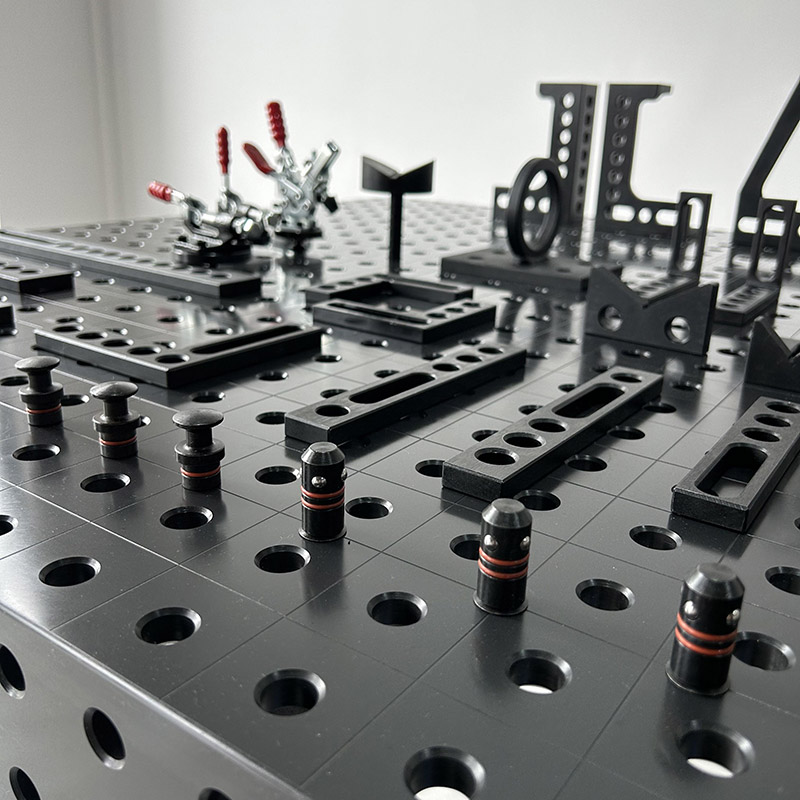
Why Choose the 3D welding tables?
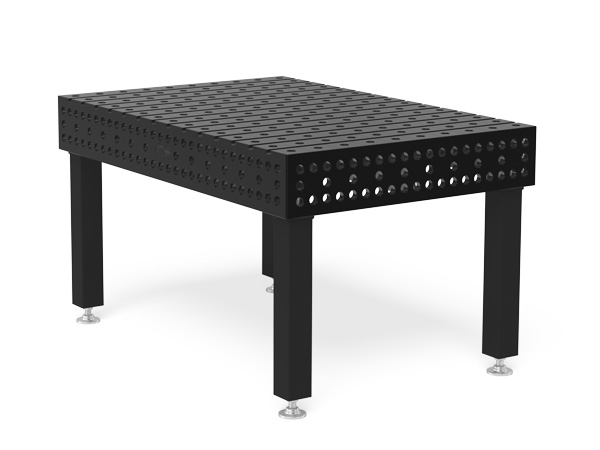
One of the advantages of opting for a 3D welding table is the level of precision it offers. While traditional flat tables may be suitable, for projects intricate welding tasks require precision in every dimension. With a 3D welding table welders have a three workspace that allows them to position their workpieces with accuracy. This not enhances the quality of the welds. Also reduces the need for extensive rework.
Versatility to Suit Projects
Whether you're working on a small scale project or tackling scale industrial applications 3D welding tables prove to be highly versatile. The adjustable fixtures and modular design of these tables can accommodate workpieces of sizes and shapes. This adaptability is crucial in todays diverse welding landscape, where professionals often face a range of projects.
Flexible modularization for rapid reconstruction
Adopting standardized grid hole systems (e.g., D28/D16) and modular components (locating pins, square boxes, support blocks, etc.), it enables quick construction of clamping schemes for different workpieces, reducing the production changeover time from 4-8 hours (traditional) to 15-30 minutes.
High-precision positioning with stability and reliability
The base hole system and plane feature high precision, with a repeat positioning accuracy of up to ±0.05mm, ensuring accurate positioning in the 3D space (X/Y/Z) and reducing welding deformation and misalignment.
Efficient integration for automation compatibility
It can be integrated with robotic welding systems, CAD/CAM software and sensors, supporting automatic path planning and thermal deformation compensation to realize 24/7 continuous production.
Cost optimization for long-term benefits
Reducing the design, manufacturing and maintenance costs of special tooling, standard parts can be reused, and the comprehensive cost decreases significantly with the increase of product batches.
 Company Profile
Hebei Yongxin's main products are the design, manufacturing, and sales of 3D flexible welding platforms, cast iron platform plates, tooling fixtures, and other measuring tools. The company has technical personnel and provides on-site installation and commissioning services for customers who purchase equipment. It also has maintenance service personnel and service vehicles to provide timely service. Furthermore, it can design and provide reasonable solutions based on specific customer requirements after site inspection. The company's products are widely used in petroleum, chemical, electronics, railway, shipbuilding, metallurgy, boiler, mining, gunpowder, liquefied gas, gas pipelines, paint factories, etc.
PRODUCT DETAILS
The rotating welding table, also known as a welding turntable, is an indispensable piece of equipment in modern welding operations. Designed to rotate workpieces 360 degrees around a horizontal or vertical axis, it revolutionizes the welding process by optimizing access to weld joints, enhancing precision, and reducing operator fatigue. Widely adopted in automotive, aerospace, manufacturing, and metal fabrication industries, this tool has become a cornerstone for high-quality, high-efficiency welding tasks.
Core Advantages: Redefining Welding Productivity
One of the primary benefits of a rotating welding table is its ability toeliminate blind spots during welding. By rotating the workpiece to position the weld joint at the optimal angle—typically flat or horizontal—it allows welders to maintain a consistent, comfortable stance, avoiding awkward postures that compromise weld quality. This not only improves the uniformity of weld beads but also minimizes defects such as porosity, undercutting, and incomplete fusion, directly boosting product reliability.
Another key advantage is time and labor savings. Traditional welding often requires manual repositioning of heavy workpieces, which is time-consuming and increases the risk of injury. A rotating welding table automates this process: with adjustable rotation speed (ranging from 0.5 to 50 RPM for most models), welders can complete complex welds in a fraction of the time. For batch production, this translates to significantly higher throughput and lower labor costs.
Additionally, the table enhancesoperator safety and comfort. By reducing the need for lifting, bending, or reaching, it minimizes the risk of musculoskeletal injuries. Many models feature anti-slip surfaces, secure clamping systems, and safety locks to prevent accidental rotation during setup or maintenance, further safeguarding the workplace.
Key Technical Features
Rotating welding tables come in a variety of configurations to suit diverse application needs, with the following core technical features:
- Load Capacity: Ranging from small benchtop models (50-500 kg) for light-duty work to heavy-duty industrial turntables (10,000+ kg) for large components like steel structures or machinery parts. The load capacity is a critical consideration, as exceeding it can damage the table’s rotation mechanism.
- Rotation Axis: Horizontal axis models are ideal for cylindrical workpieces (e.g., pipes, tubes, tanks), while vertical axis tables excel at flat or irregularly shaped parts. Some advanced models offer dual-axis rotation for complex 3D workpieces.
- Rotation Speed: Most tables feature stepless speed adjustment, allowing welders to match the speed to the welding process (MIG, TIG, arc welding) and workpiece material (steel, aluminum, stainless steel).
- Clamping System: Equipped with adjustable clamps, vises, or custom fixtures to secure workpieces firmly during rotation. This ensures stability and prevents displacement, which is essential for precision welding.
- Material and Durability: Constructed from high-strength steel with anti-corrosion coatings, the table surface is resistant to welding spatter and heavy impacts. The rotation mechanism uses sealed bearings for smooth operation and long service life with minimal maintenance.
| parameter category | specific indicators |
| platform dimensions | 1000×1000×200 mm、1000×1200×200 mm、1000×1500×200 mm、1000×2000×200 mm、1200×1200×200 mm、1200×2400×200 mm、1500×1500×200 mm、1500×2000×200 mm、1500×2500×200 mm、1500×3000×200 mm、2000×3000×200 mm、2000×4000×200 mm. The height of the platform side is usually 200mm |
| flatness | ≤0.10 mm / 1000 mm |
| perpendicularity | The perpendicularity between the side and upper surface of the workbench is ≤ 0.10 mm/200 mm |
| surface roughness | Ra ≤ 3.2 μm12 |
| graduation mark | The platform surface is engraved with 100 × 100 mm grid lines, with a positional tolerance of ± 0.05 mm |
| Hole specifications | - Φ28 series:Aperture 28mm, hole spacing 100 ± 0.05mm, hole tolerance D10 level- Φ16 series:Aperture 16mm, hole spacing 50 ± 0.05mm, hole tolerance D10 level 12 |
| material |
-Tabletop: Q345 low-alloy steel (welded structure) or HT300 cast iron (cast structure), both undergo integral stepped heat treatment to eliminate internal stress -Accessories (square box, angle iron, locking parts, etc.): usually made of Q345 steel or HT300 cast iron |
| load-bearing capacity |
-Standard countertop: 2 tons (T) -Frame type support: 5 tons (T) -Lift type support: 3 tons (T) -Brake universal wheel type: 1 ton (T) |
FAQ
Can the size and logo be customized?
In addition to the regular size, different sizes and thicknesses can be customized according to the actual processing needs of the customer.
Can technical advice and consultation be provided?
Of course, we provide you with professional technical advice and usage guidance
Does it meet the export packaging requirements?
We use plywood wooden boxes to ensure thatmeet export requirements, and, in order to minimize transportation costs, before shipment, the packaging size of the product is carefully calculated. No packaging space is wasted.
Is there a professional export department?
We have professional export personnel with more than 15 years of experience, providing full-service from quotation, ordering, shipping, and receipt. We ensure that every link of your import can be completed in a timely and smooth manner.
How do you ensure quality?
Pre-production samples are always provided before mass production; final inspection is always performed before shipment.
How is your quality control?
Our quality control steps include:
(1) Confirm everything with the customer before purchasing and production; (2) Check all materials to ensure they are correct; (3) Hire experienced workers and train them properly; (4) Perform inspections throughout the production process; (5) Strict quality control before shipment
 2026-06-23
Hebei Yongxin Measuring Tools
Copyright © 2025-2026 http://www.yx-weldingtable.com. All Rights Reserved Hebei Yongxin Measuring ToolsCopyright