






- Navigation -
 Current Location:
NEWS DETAILS
NEWS INFORMATION
What is the required flatness tolerance for a 3D welding table?
AUTHOR:yongxin DATE:2026-02-22 15:40:21 HITS:72
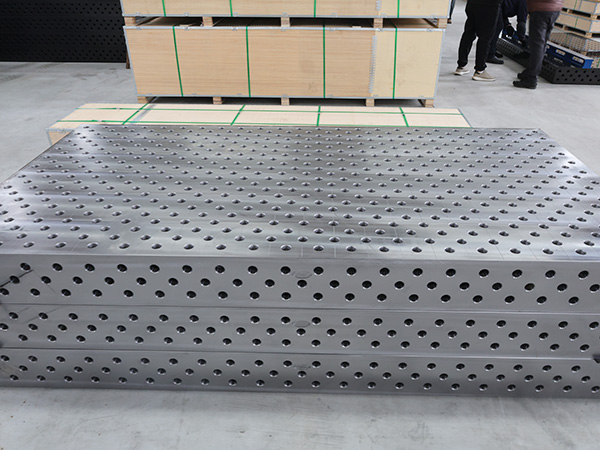
The flatness tolerance of a 3D welding table is defined by accuracy grade and application scenarios, with three core industry-standard tolerance levels for different welding needs. A quality 3D welding table (typically high-strength cast iron with heat treatment and rigid ribbed structure) is also required to maintain this flatness long-term and resist welding-induced deformation.
Core Flatness Tolerance Specifications
High-precision grade
Flatness ≤ 0.05 mm/m
For precision jigging, inspection work, and robotic welding (demands the strictest dimensional accuracy for automated/ precision welding).
Industrial standard grade
Flatness ≤ 0.1 mm/m
The most common and widely used tolerance; suitable for general professional welding, industrial fixturing, and mainstream fabrication work.
Economic grade
Flatness ≤ 0.2 mm/m
For light-duty welding tasks and non-critical fabrication applications with lower precision requirements.
Key Note for Flatness Retention
To preserve the specified flatness over service life, the table should be manufactured from high-strength cast iron, undergo stabilized heat treatment, and feature a rigid ribbed structural design—all to prevent deformation from welding heat, heavy loads, and repeated use.
-
Modular Fixture System for Welding Automation Efficiency
-
3D Flexible Welding Platform Advantages in Fabrication
-
Welding Bench Setup Guide for Workshop Efficiency
-
Steel vs Aluminum Welding Tables: Frame System Comparison
-
Welding Fixture Table Setup Guide for Better Accuracy
-
Why Steel Welding Tables Dominate Industrial Workshops
Hebei Yongxin Measuring Tools
Copyright © 2025-2026 http://www.yx-weldingtable.com. All Rights Reserved Hebei Yongxin Measuring ToolsCopyright