






- Navigation -
 Current Location:
NEWS DETAILS
NEWS INFORMATION
How to Avoid Defects in 3D Flexible Welding Platform Castings
AUTHOR:yongxin DATE:2026-02-22 13:54:44 HITS:118
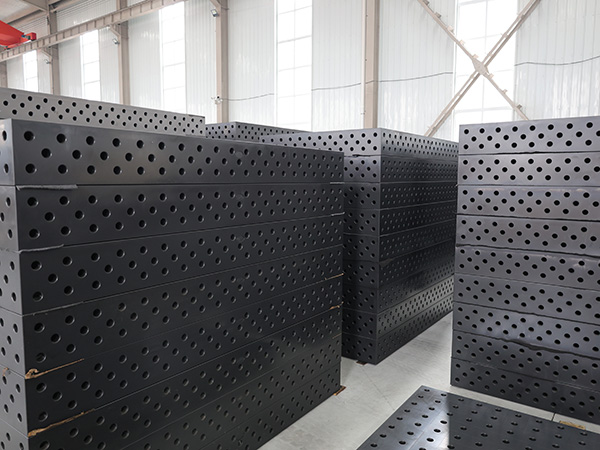
Cast holes on the flat wall of the welding platform casting shall be reinforced with flanges to reduce wall thickness.
Connections between casting walls shall be free of sharp angles and metal accumulation. A gradual transition shall be applied between thick and thin walls to avoid sudden changes, which may cause hot spots, stress concentration, hot cracking, or shrinkage porosity.
To ensure good formability of 3D flexible welding platform castings, the minimum wall thickness shall be controlled above the allowable limit.
Large-area sandwich cavities such as water channels and air passages inside castings shall be provided with several connecting columns.
The wall thickness of castings shall be as uniform as possible to prevent shrinkage cavities and hot cracking. For directional solidification, the wall thickness shall vary gradually in one direction; for simultaneous solidification, the wall thickness shall be kept constant.
Large horizontal surfaces inside castings shall be avoided as much as possible.
The casting structure shall allow unobstructed shrinkage during cooling.
Local thick sections of the platform casting shall be hollowed out or provided with cast holes, and properly reinforced with ribs.
During operation, the 3D flexible welding platform is subjected to certain loads. If the stiffness of the inspection plate is insufficient, the deformation caused by the load will be significant, resulting in poor flatness and loss of its function as a reference surface. Therefore, the stiffness of the cast iron plate is a critical factor affecting its working accuracy, and is an important indicator for evaluating the quality of the 3D flexible welding platform.
The flexible 3D modular tooling system features high load capacity and stable rigidity. Under a concentrated load of approximately 1 ton, the deformation is only 0.553 mm; under a uniformly distributed load, the deformation is only 0.024 mm. These values fully meet the requirements of most welding, assembly, and machining applications. All modules are manufactured with high precision; the center distance tolerance of the positioning holes on the working table is ±0.05 mm, providing excellent positioning accuracy.
Although the 3D flexible welding platform is a reusable flexible tooling, its nature requires sufficient structural strength and rigidity to ensure positioning accuracy. Meanwhile, the flexible functionality results in a more complex structure compared with conventional rigid tooling. Therefore, structural optimization design technology based on the characteristics of flexible tooling is essential in flexible tooling design.
The structural optimization design technologies for flexible tooling of 3D welding plates mainly include:
Lightweight design and optimization of the tooling structure (especially the frame structure) and static stiffness deformation analysis
Structural modal analysis according to actual working conditions
Analysis of the influence of flexible characteristics on the structure
Structural design of modular units
GB/T 7714:Vogel R, Steiner M. Quality evaluation and performance testing of modular 3D flexible welding fixture tables[J]. Journal of Manufacturing and Materials Processing, 2024, 8(5):108.
APA:Vogel, R., & Steiner, M. (2024). Quality evaluation and performance testing of modular 3D flexible welding fixture tables. Journal of Manufacturing and Materials Processing, 8(5), 108.
-
Modular Fixture System for Welding Automation Efficiency
-
3D Flexible Welding Platform Advantages in Fabrication
-
Welding Bench Setup Guide for Workshop Efficiency
-
Steel vs Aluminum Welding Tables: Frame System Comparison
-
Welding Fixture Table Setup Guide for Better Accuracy
-
Why Steel Welding Tables Dominate Industrial Workshops
Hebei Yongxin Measuring Tools
Copyright © 2025-2026 http://www.yx-weldingtable.com. All Rights Reserved Hebei Yongxin Measuring ToolsCopyright